
Choosing a battery module PACK line is not simply a matter of comparing machine prices or headline production capacity. The right production line needs to match the battery cell format, module structure, target throughput, automation requirements, traceability system, and future product plans.
For battery manufacturers, an unsuitable line can lead to longer changeover times, production bottlenecks, higher labor requirements, or costly modifications later.
This guide explains five technical criteria to evaluate when selecting a battery module PACK line, along with the practical questions manufacturers should ask before finalizing a technical proposal.
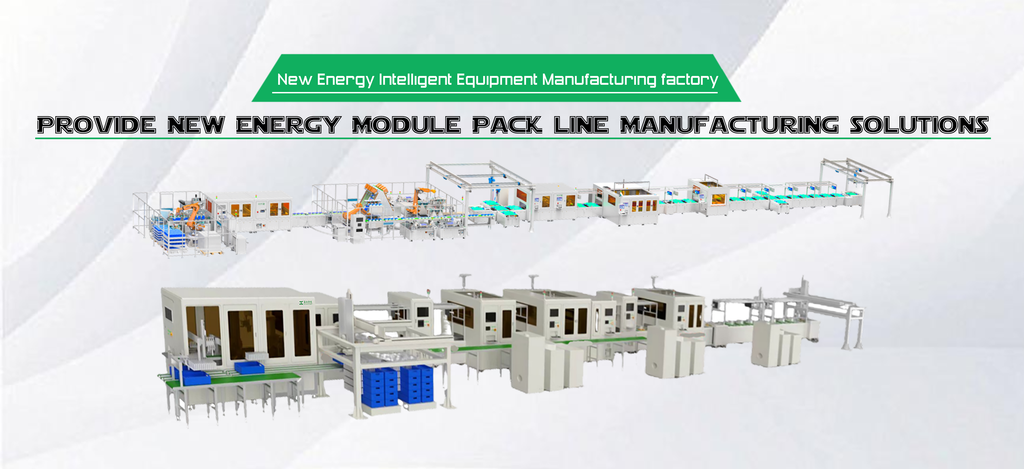
What Does a Battery Module PACK Line Actually Do?
A battery module PACK line is an automated production system designed to assemble lithium battery cells into battery modules and, depending on the project scope, complete battery packs.
The exact production process varies according to the cell format, module structure, battery application, and required automation level.
On the module side, typical processes may include cell loading, cell identification and inspection, polarity checking, cleaning, cell arrangement or stacking, busbar or CCS assembly, laser welding, electrical testing, and insulation testing.
For projects that include pack assembly, additional processes may include module loading, structural assembly, high-voltage connection, BMS installation, communication testing, and end-of-line inspection.
On a typical prismatic battery module PACK project, the production line can be configured across multiple automated stations, with robots, material handling systems, vision systems, welding equipment, testing systems, and production data management integrated according to the customer’s process requirements.
Understanding the complete process is important because each of the five criteria below affects a different part of the production line.
1. Which Cell Formats Does the Line Need to Handle?
Cell format is one of the first factors to define because it directly affects the mechanical architecture of the production line.
Prismatic, cylindrical, and pouch cells require different handling, fixturing, testing, and assembly configurations. A line designed around one cell format cannot normally be converted to another format through software changes alone.
Prismatic cells require rigid support and accurate positioning during handling and assembly. Cylindrical cells require fixtures, grippers, and testing components designed around the specific cell diameter and arrangement. Pouch cells require different handling methods because of their flexible structure and exposed tabs.
The testing principles may overlap across different cell formats, but the mechanical and process design can be substantially different.
What to Ask the Equipment Supplier
Before selecting a line, ask:
- Which cell formats does the proposed architecture support?
- What cell dimensions and tolerances are supported?
- Are fixtures interchangeable?
- Which components need to be replaced during changeover?
- How are testing modules adapted to different cell specifications?
- What is the actual changeover procedure?
If you plan to manufacture more than one battery format, these questions should be answered during the technical proposal stage rather than after the equipment has been built.
Jialuo Intelligent develops dedicated production-line solutions for different battery cell formats rather than treating different cell types as interchangeable through software alone.
For reference, prismatic battery module PACK lines can typically achieve approximately 12–15 PPM, depending on the module structure, process configuration, and production requirements.
2. What Takt and Throughput Should You Specify?
Throughput is commonly expressed as PPM (parts per minute), but the number is only meaningful when the cell format, module structure, and production conditions are clearly defined.
For example, a quoted production rate should specify whether it refers to cells, modules, packs, or another production unit.
For prismatic battery module production, a line may typically operate at approximately 12–15 PPM, depending on the final configuration.
The more important question, however, is whether the production takt is balanced across the entire line.
A sorting station that runs significantly faster than the welding station may create work-in-process accumulation. Conversely, if a downstream testing station has a longer cycle time than the upstream assembly stations, operators or equipment may be left waiting.
For this reason, manufacturers should evaluate the complete production flow rather than focusing only on the highest single-station speed.
What to Ask the Equipment Supplier
Ask for:
- Target production takt
- Cycle time for each critical station
- Planned bottleneck station
- Rated production capacity
- OEE definition and acceptance criteria
- Conditions under which the quoted capacity is achieved
A good technical proposal should clearly distinguish between reference production capacity and the capacity calculated specifically for your battery product.
3. How Much Automation Do You Actually Need?
Automation level affects equipment investment, labor requirements, production consistency, and long-term operating costs.
The appropriate automation level depends on production volume, product stability, labor availability, process complexity, and the customer’s quality requirements.
A highly automated battery module PACK line may integrate robotic loading and unloading, automated material transfer, vision-guided positioning, automatic assembly, laser welding, inspection, testing, and production data collection.
For high-volume production, automation can help reduce repetitive manual operations and improve process consistency.
However, not every station needs to be fully automated.
Some low-volume or high-variation processes may benefit from manual or semi-automatic operation when flexibility is more important than maximum throughput.
Automation Rate Is Not the Only Metric
A line with a high automation rate is not necessarily the right solution if the automation does not match the production process.
When evaluating automation, consider:
- Automation rate
- Production capacity
- Equipment utilization
- OEE
- Positioning accuracy
- Welding process stability
- Inspection capability
- Material handling efficiency
- Labor requirements
- Maintenance requirements
For Jialuo Intelligent’s prismatic module PACK solutions, line automation can exceed 95% and OEE can reach 85% or above, depending on the final line configuration and project requirements.
These figures should be treated as reference values rather than universal specifications. Actual performance should be defined and verified according to the customer’s product, process, and acceptance criteria.
What to Ask the Equipment Supplier
Ask how the supplier defines:
- Automation rate
- OEE
- Production capacity
- Equipment availability
- Acceptance testing conditions
This helps ensure that performance figures from different suppliers are being compared on the same basis.
4. What Level of Traceability Does Your Customer Require?
Traceability requirements should be defined before the production line is designed.
For battery manufacturing projects, traceability may involve cell barcode scanning, cell-to-module data binding, process parameters, inspection results, welding information, test results, and production records.
For projects serving automotive supply chains, barcode binding and MES integration are often required or strongly preferred, depending on the customer’s quality and traceability requirements.
For energy storage projects, the required level of traceability may vary according to the customer’s internal data-management standards.
Why Should Traceability Be Defined Early?
Traceability is not simply a software feature added at the end of a project.
A complete traceability system may involve:
- Barcode or QR code scanning
- Data acquisition
- PLC communication
- Equipment interfaces
- MES integration
- Production databases
- Process data collection
- Data storage and export
Adding these functions after the equipment has already been designed can require additional hardware, software, and integration work.
What to Ask the Equipment Supplier
Before approving the technical proposal, clarify:
- Which production data needs to be collected?
- Which data points need to be stored?
- How long must production records be retained?
- Does the line need to connect to an existing MES?
- Which communication protocols are required?
- Can production data be exported to the customer’s system?
Defining these requirements early helps avoid unnecessary modifications during installation and commissioning.
5. How Fast Does the Line Need to Change Over?
Changeover time becomes increasingly important when a battery manufacturer produces multiple module variants or works with different product configurations.
A flexible production line should allow operators and engineers to change products efficiently while maintaining process consistency.
Changeover may involve a combination of:
- Modular fixtures
- Quick-change tooling
- Servo parameter programs
- Recipe management
- Adjustable material handling systems
- Product-specific welding parameters
- Software configuration
The actual changeover time depends on the equipment architecture and the number of components that need to be physically adjusted or replaced.
For this reason, manufacturers should not evaluate changeover based only on a software demonstration.
What to Ask the Equipment Supplier
Ask:
- How many product recipes can the system store?
- Which fixtures need to be changed?
- Which components require manual adjustment?
- How long does a complete changeover take?
- Is the quoted changeover time measured under actual production conditions?
- Can the changeover procedure be included in the acceptance criteria?
The objective is not simply to achieve the shortest possible changeover time, but to build a production system that can efficiently support the customer’s actual product mix.
What Should a Technical Proposal Contain?
A battery module PACK line is a customized production system, so a technical proposal should contain more than a single equipment price and a headline production rate.
A proposal should clearly define:
- Supported cell format and dimensions
- Module structure
- Production capacity
- Station-by-station takt
- Automation level
- OEE definition
- Testing requirements
- Welding processes
- Traceability architecture
- MES interface requirements
- Changeover procedure
- Equipment scope
- Installation and commissioning scope
- Acceptance criteria
It is also important to distinguish typical reference parameters from project-specific specifications.
The same battery module PACK architecture can produce different capacity, takt, accuracy, and automation results depending on the customer’s cell specification, module structure, process route, and required automation level.
Manufacturers should therefore be cautious about proposals that quote a production capacity without clearly stating the battery format and module configuration to which the figure applies.
Frequently Asked Questions
How long does it take to build and deliver a battery module PACK line?
Project timelines vary according to equipment type, configuration, and project scope.
For Jialuo Intelligent projects, domestic steel strap line projects can typically be completed within approximately 7–10 days, while other domestic module production line projects may require around 30 days. For overseas projects, on-site installation and commissioning can typically be completed within one month, depending on project scope, equipment configuration, and site conditions.
Before shipment, equipment is pre-commissioned at the manufacturing facility to help verify the production process and equipment operation.
Is on-site installation and commissioning included?
Jialuo Intelligent provides on-site installation and commissioning support through engineers and technicians.
For overseas projects, interpretation support is also available to facilitate communication between the Jialuo engineering team and the customer’s local team.
The exact scope of on-site services is defined according to the project contract and technical proposal.
Can an existing line be upgraded to handle a new cell format?
It depends on the existing equipment architecture.
Mechanical travel, fixtures, grippers, testing components, welding processes, software, and safety systems may all affect whether a new cell format can be introduced.
Some modifications may be relatively straightforward, while others may require substantial mechanical or electrical changes.
The feasibility of an upgrade should therefore be evaluated against the existing equipment configuration and the technical requirements of the new battery product.
Do you supply pouch cell lines and CCS assembly equipment?
Yes.
Jialuo Intelligent develops battery automation solutions for different cell formats and provides CCS assembly solutions that can be configured according to the customer’s CCS structure and process requirements.
Depending on the project, CCS production may include processes such as pulse hot riveting, laser welding, AOI inspection, and electrical testing.
The final station configuration is determined according to the customer’s product structure, production capacity, and quality requirements.
How Are Production Parameters Validated?
Reference parameters presented in technical materials should be treated as typical values for a specific configuration.
Actual production capacity, takt, accuracy, automation level, and testing performance should be calculated against the customer’s:
- Cell specification
- Module structure
- Production process
- Target capacity
- Automation requirements
- Quality standards
The final specifications should be confirmed in the project technical proposal and equipment acceptance criteria.
About Jialuo Intelligent
Shenzhen Jialuo Intelligent Technology Co., Ltd. develops intelligent equipment and production-line solutions for lithium battery manufacturing.
Our product portfolio includes:
- Battery Module PACK Production Lines
- Battery Module Steel Strap Forming Lines
- CCS Automated Production Lines
- Prismatic Cell Cover Plate Assembly and Welding Equipment
- Battery Module Testing Solutions
- Customized Lithium Battery Automation Equipment
Founded in 2008, Jialuo Intelligent has focused on intelligent equipment for the new energy and lithium battery industry since 2019.
Our engineering capabilities cover mechanical design, automation control, equipment integration, production-line commissioning, and customized manufacturing solutions.
For customers in China and overseas markets, we provide equipment development, factory pre-commissioning, on-site installation, commissioning, and technical support according to project requirements.
Looking for a Battery Module PACK Line?
Every battery manufacturing project has different requirements for cell format, module structure, production capacity, process flow, testing, traceability, and automation.
If you are planning a new battery module production line or upgrading an existing manufacturing process, share your battery specifications and production requirements with our engineering team.
We can evaluate the required production process and develop a battery automation solution based on your project requirements.
Shenzhen Jialuo Intelligent Technology Co., Ltd.
Room 101, Building 2, No. 8, Chengguang Industrial Park, Kukeng, Dafu Community, Guanlan Street, Longhua District, Shenzhen, China
Email: jch@cnjialuo.com
WhatsApp: +86 181 2473 5015
Jialuo Intelligent | Battery Automation Solutions