
Choosing a battery module PACK line is not simply about selecting the fastest machine.
For lithium battery manufacturers, the right production line needs to match the cell format, module structure, target capacity, automation level, quality requirements, and traceability needs of the project.
A line that works well for one battery product may require significant changes for another. That is why technical specifications should be confirmed before comparing suppliers or equipment prices.
This guide explains the five key criteria to consider when selecting a battery module PACK line, from cell compatibility and production capacity to automation, changeover flexibility, and data traceability.
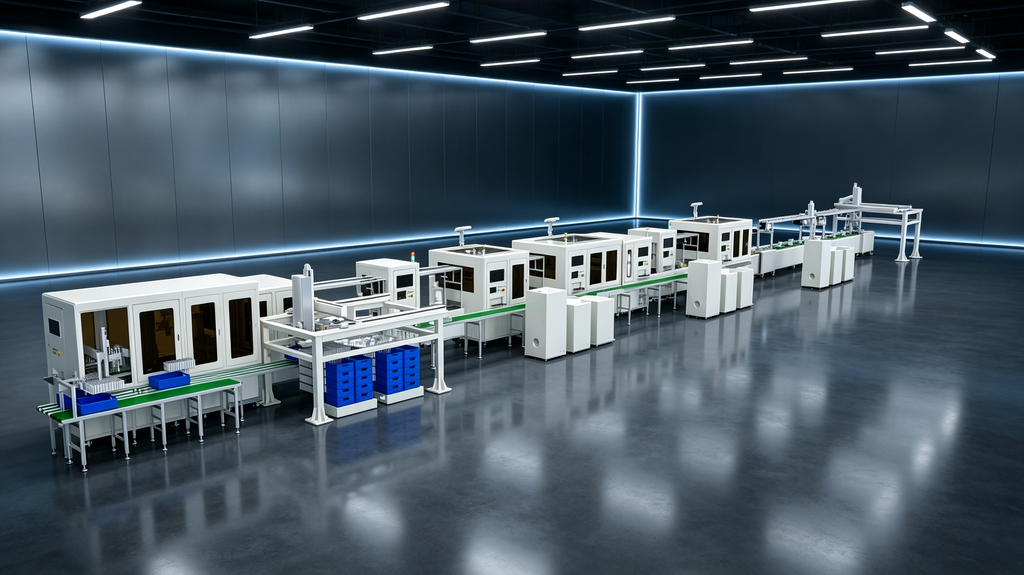
What Should You Clarify Before Specifying a PACK Line?
Before requesting a quotation, several basic parameters should be clearly defined.
First, confirm the cell format — prismatic, pouch, or cylindrical.
Then define the target module structure, production capacity, process route, automation requirements, and data traceability requirements.
These factors directly affect the mechanical design, station layout, testing system, welding process, and overall configuration of the battery module PACK line.
A production line designed for one module structure should not automatically be assumed to support another without engineering evaluation.
1. Which Cell Format Does the PACK Line Need to Handle?
The cell format is one of the first technical factors to confirm because it affects the mechanical architecture of the entire production line.
A typical prismatic battery module PACK line may include processes such as:
- Cell loading
- Cell height measurement
- OCV testing and sorting
- Cell flipping and pairing
- Adhesive application
- Cell stacking
- Polarity detection and addressing
- Laser cleaning
- Busbar placement and welding
- Electrical testing
- Insulation testing
- Module and PACK assembly
Different cell formats require different handling, fixtures, testing arrangements, and process configurations.
For reference, one typical prismatic automatic configuration may reach approximately 12–15 PPM. A pouch semi-automatic configuration may reach around 10–12 PPM, while a cylindrical automatic configuration may reach approximately 30–40 PPM.
These figures are reference values for specific equipment configurations. Actual cycle time depends on the customer’s cell specification, module structure, process route, station configuration, and required automation level.
The final production capacity should therefore be confirmed in the technical proposal and equipment acceptance criteria.
What Should You Ask the Supplier?
Before ordering, confirm:
- Which cell formats are supported?
- What cell dimensions and weight ranges are supported?
- Are dedicated fixtures required?
- What mechanical changes are required for different products?
- What is the expected cycle time for the customer’s actual module design?
A software parameter change alone does not necessarily mean that a production line can mechanically support a different cell format.
2. How Should You Set the Target Cycle Time?
Cycle time is commonly expressed as PPM, or modules per minute.
However, the headline PPM number is only meaningful when the cell format, module structure, process route, and operating conditions are clearly defined.
Instead of starting with a desired PPM figure, it is often more practical to define the required per-shift output first.
For example, the supplier can then calculate the required takt time, station configuration, buffer positions, and equipment quantity based on the planned production capacity.
The key is to balance the entire production line rather than optimize only one station.
If the cell sorting station runs significantly faster than the welding station, work-in-process may accumulate before welding. If testing becomes the bottleneck, upstream stations may have to wait.
What Should You Ask the Supplier?
A technical proposal should ideally clarify:
- Target cycle time
- Station-by-station takt
- Bottleneck station
- Buffer configuration
- Planned operating time
- Expected production capacity
- OEE definition, where applicable
This gives a more realistic picture of production capacity than looking at a single PPM number.
3. What Level of Automation Should You Choose?
The appropriate automation level depends on production volume, product stability, labor availability, process requirements, and the number of product variants.
For a battery module PACK line, high-repeatability processes such as loading, positioning, welding, inspection, and testing are often suitable for automation.
Other operations may remain manual or semi-automatic when product variations are frequent or when flexibility is more important than maximum automation.
A fully automated line may integrate robots, conveyors, vision systems, automatic handling, welding equipment, inspection systems, and data collection.
At the same time, a semi-automatic configuration may be more appropriate for pilot production, lower-volume products, or projects where the battery design is still changing.
The goal should not simply be to achieve the highest possible automation rate.
Instead, the automation level should be designed around the customer’s production volume, product structure, labor strategy, and return-on-investment requirements.
What Should You Ask the Supplier?
Ask the supplier to clearly separate:
- Automatic processes
- Semi-automatic processes
- Manual processes
- Operator requirements
- Inspection functions
- Robot functions
- Data collection functions
This makes it easier to compare different equipment proposals on the same basis.
4. Why Does Changeover Flexibility Matter?
If a factory produces multiple battery module variants, changeover time can directly affect usable production capacity.
A flexible battery module PACK line may use adjustable fixtures, programmable process parameters, and recipe-based control to support different product variants.
However, the actual changeover method depends on the module structure and the mechanical design of the line.
Some product changes may require only parameter or tooling adjustments, while others may require fixture replacement or mechanical modification.
For this reason, suppliers should explain the actual changeover procedure rather than simply describing a line as “flexible.”
What Should You Ask the Supplier?
Before ordering, confirm:
- How many module variants will be produced?
- What fixtures are shared?
- Which tooling needs to be changed?
- Which parameters are stored in recipes?
- How long does the complete changeover take?
- Is operator intervention required?
- What commissioning or verification is required after changeover?
If several products will share one line, these details should be included in the technical proposal.
5. Why Is Data Traceability Important?
Traceability is becoming an important requirement for battery manufacturing, particularly when customers need detailed process records for quality management.
A battery module PACK line can be configured to collect production and inspection data and, where required, connect with an MES system.
Depending on the project, traceability may include:
- Cell barcode information
- OCV test results
- Sorting information
- Welding parameters
- Electrical test results
- Insulation test results
- Module identification
- Production time
- Equipment status
- Quality inspection results
The exact data structure depends on the customer’s quality system and MES architecture.
For this reason, traceability requirements should be defined before equipment design rather than added after installation.
What Should You Ask the Supplier?
A technical proposal should clarify:
- Which data points are collected?
- Which data points are linked to the module ID?
- How long is production data retained?
- Does the line connect to the customer’s existing MES?
- What communication protocol or data interface is required?
- Which inspection results are stored?
Defining these requirements early can help avoid costly changes during installation or acceptance.
What Should a Technical Proposal for a PACK Line Include?
A detailed technical proposal should contain more than a single production-capacity figure.
At minimum, it is useful to clarify:
Product Information
- Cell format
- Cell dimensions
- Cell weight
- Module structure
- Product variants
Production Requirements
- Target production capacity
- Cycle time
- Shift requirements
- Expected operating conditions
Automation Configuration
- Automatic stations
- Semi-automatic stations
- Manual operations
- Robot configuration
- Vision inspection
Quality and Testing
- OCV testing
- Electrical testing
- Insulation testing
- Welding inspection
- Other product-specific quality requirements
Traceability
- Barcode binding
- Process data collection
- MES integration
- Data storage
- Production records
Changeover
- Product variants
- Fixture requirements
- Recipe management
- Tooling changes
- Expected changeover procedure
The same battery module PACK line architecture can produce different takt times, capacity, and automation levels depending on the customer’s actual product and process requirements.
Therefore, reference parameters should always be distinguished from project-specific specifications.
What Support Should You Expect From the Equipment Supplier?
The equipment itself is only one part of a successful production-line project.
For a complete battery module PACK line, technical support may include equipment design, manufacturing, factory pre-commissioning, transportation preparation, installation, commissioning, operator training, and after-sales service.
For domestic projects, equipment can normally be pre-commissioned at the supplier’s facility before shipment, followed by installation and commissioning at the customer’s factory.
The actual project schedule depends on the equipment scope, technical configuration, factory conditions, and agreed implementation plan.
For overseas projects, installation and commissioning can also be supported by engineering and technical personnel, with interpretation support where required.
What Should You Ask the Supplier?
Before signing the contract, clarify:
- Factory pre-commissioning scope
- On-site installation scope
- Commissioning responsibilities
- Operator training
- Remote technical support
- Spare-parts support
- Warranty terms
- Response time for after-sales service
A clear implementation plan can be just as important as the equipment specifications themselves.
Frequently Asked Questions
How Long Does Installation and Commissioning Take?
Equipment is normally pre-commissioned at the supplier’s facility before shipment and then installed and commissioned at the customer’s site.
The actual schedule depends on the production-line scope, equipment configuration, site conditions, and agreed technical proposal.
Pre-commissioning can help reduce the amount of debugging required after the equipment arrives at the customer’s factory.
What Parameters Should You Confirm in the Quotation?
Before comparing quotations, confirm at least:
- Target cycle time
- Production capacity
- Automatic and manual process list
- Cell format and product range
- Testing configuration
- Welding process
- Traceability requirements
- MES interface
- Changeover procedure
- Installation and commissioning scope
A detailed technical proposal makes it easier to compare equipment based on actual project requirements rather than only price or headline PPM.
Can One PACK Line Handle Different Cell Formats?
It depends on the equipment architecture and the specific products.
Prismatic, cylindrical, and pouch cells have different mechanical structures and handling requirements. A line designed for one format should not automatically be assumed to support another format without engineering evaluation.
If multiple cell formats are planned, this requirement should be confirmed during the initial technical design stage.
Can a PACK Line Be Customized?
Yes.
Battery module production lines are typically configured according to the customer’s:
- Cell specifications
- Module structure
- Production capacity
- Process requirements
- Automation level
- Testing requirements
- Traceability requirements
- Factory layout
The final equipment configuration should be confirmed through a project-specific technical proposal.
About Jialuo Intelligent
Shenzhen Jialuo Intelligent Technology Co., Ltd. provides intelligent equipment and production-line solutions for lithium battery manufacturing.
Founded in 2008, Jialuo Intelligent has focused on intelligent equipment for the new energy and lithium battery industry since 2019.
Our product portfolio includes:
- Battery Module PACK Production Lines
- Battery Module Steel Strap Forming Lines
- CCS Automated Production Lines
- Prismatic Cell Cover Plate Testing and Assembly Equipment
- Semi-Automatic Cell Wrapping (Blue Film) Machines
- Cylindrical, Prismatic, and Pouch Cell Sorting Machines
- Customized Lithium Battery Automation Equipment
Our engineering capabilities cover mechanical design, automation control, equipment integration, production-line commissioning, and customized manufacturing solutions.
For each project, equipment configuration and technical parameters are developed according to the customer’s actual product and production requirements.
Planning a Battery Module PACK Line?
Every battery module project has different requirements.
Before selecting equipment, prepare the following information:
Cell format + cell specification + module structure + target output + process route + automation requirements + testing requirements + traceability requirements
With these parameters defined, the equipment supplier can develop a more suitable station layout and technical proposal.
If you are planning a new battery module PACK line, upgrading an existing production line, or evaluating an automated battery manufacturing solution, share your product specifications and process requirements with our engineering team.
Shenzhen Jialuo Intelligent Technology Co., Ltd.
Address: No. 8, Building 2, Kukeng Chengguang Industrial Park, Dafu Community, Guanlan Street, Longhua District, Shenzhen, China (518100)
Email: jialuozn@163.com