A Cell Contact System (CCS) is a critical assembly within a battery module, combining electrical connections with voltage and temperature sensing functions. Depending on the CCS design, the production process may involve two important joining technologies: pulse hot riveting and laser welding.
These two processes are often discussed together, but they serve different purposes. Understanding the difference is important when specifying a CCS production line, because the joining sequence, positioning method, testing requirements, and inspection system all affect the final line configuration.
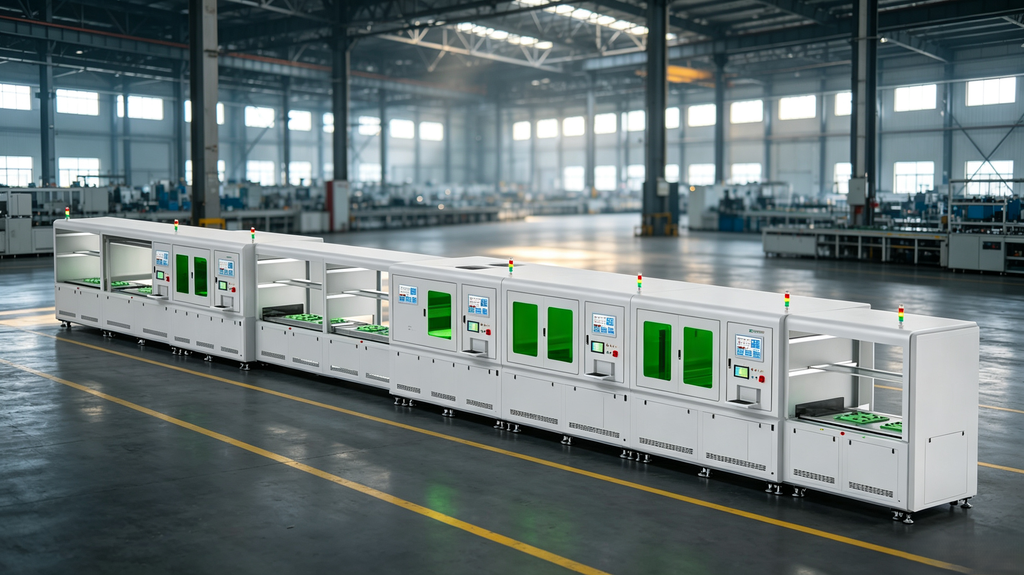
This guide explains what pulse hot riveting and laser welding do in CCS manufacturing, why they are commonly arranged in a specific sequence, and which technical parameters battery manufacturers should clarify before selecting a CCS automated production line.
What Is a Cell Contact System (CCS)?
A Cell Contact System is an electrical interconnection and sensing assembly used inside a battery module. It typically combines several components, including:
- An FPC or FFC sensing harness for voltage and temperature signals
- Aluminum busbars for cell electrical connections
- Nickel sheets used in the electrical joining structure
- Connectors for connection to the battery management system (BMS)
- Insulating film or a carrier structure for positioning and protection
Because the CCS combines sensing and electrical connection functions, the reliability of each joint is important to the overall performance of the battery module.
A positioning error, incomplete weld, damaged sensing circuit, or incorrectly assembled connector can affect electrical continuity, signal acquisition, or downstream testing results.
For this reason, joint reliability, positioning accuracy, electrical testing, and inspection capability are key considerations when designing a CCS production line.
Pulse Hot Riveting and Laser Welding: Two Different Jobs
Pulse hot riveting and laser welding are complementary processes rather than interchangeable ones.
Pulse hot riveting is primarily a mechanical fixation process. Heated riveting tools soften and form plastic posts to secure the FPC, busbar, and carrier components in their designed positions.
Laser welding is an electrical joining process. Depending on the CCS design, it can be used to join nickel sheets and busbar components to create a reliable electrical connection.
In simple terms:
Hot riveting helps hold the CCS assembly in position, while laser welding creates the required electrical joints.
Because the two processes perform different functions, they should be evaluated as separate process steps when specifying a CCS production line.
Why Does Hot Riveting Typically Come Before Laser Welding?
Hot riveting establishes the mechanical position of the CCS components before the welding process.
Once the FPC, busbar, carrier, and related components are fixed in position, downstream welding and inspection stations can work from a more stable reference.
If components need to be re-fixtured or transported between separate process areas, additional handling and positioning steps may introduce cumulative positioning errors.
For this reason, a well-integrated CCS production line may combine hot riveting, laser welding, electrical testing, and AOI inspection into a continuous production flow, using consistent carrier positioning and process references.
The exact process sequence, however, should be determined by the CCS structure and customer’s manufacturing requirements.
How Is Pulse Hot Riveting Configured?
A pulse hot riveting station can use a multi-head structure so that multiple riveting points can be processed within a single production cycle.
For reference, one typical configuration may include:
- 12 riveting heads
- Single-point pulse hot riveting time of approximately 10 seconds
- Positioning repeatability of approximately ±0.05 mm
- Independent temperature control for individual hot-melt nozzles
- Real-time temperature monitoring
Independent temperature control can help maintain consistent riveting conditions across different points of the assembly.
Because different riveting positions may have different material thicknesses, structures, or thermal characteristics, individual temperature control allows the process parameters to be adjusted according to the actual joint requirements.
The number of riveting heads is not necessarily fixed. It can be configured or expanded according to the customer’s product structure and total riveting point count.
Important: The parameters above are reference values for a specific configuration. The final riveting head count, cycle time, accuracy, and temperature-control requirements should be confirmed according to the customer’s CCS design and technical proposal.
How Is Laser Welding Configured?
Laser welding is used to create electrical connections within the CCS assembly.
Because CCS welding typically involves thin metal components, weld quality depends not only on laser power but also on part positioning, clamping, focus control, and welding path accuracy.
A typical laser welding station may address these requirements through several functions.
Clamping and Position Control
The welding fixture may use a brass clamping structure combined with a spring mechanism.
The spring provides controlled compression during clamping, helping maintain contact between the components while reducing the risk of excessive mechanical pressure.
Focus Distance Detection
Focus distance detection helps maintain the correct laser focal position during welding.
For one reference configuration, focal distance detection accuracy is approximately ±0.1 mm, with automatic focus adjustment.
The actual specification should be determined according to the material, thickness, welding structure, and laser process used in the project.
Vision-Based Alignment
A vision system can identify the actual position of the nickel sheet and automatically correct the welding position before the laser process begins.
This approach helps compensate for small positioning deviations and improves the consistency of the welding path.
Under a specific reference configuration, the laser welding pass-rate target may be approximately 98% or higher.
However, welding yield depends on the material, joint structure, laser parameters, fixture accuracy, production conditions, and acceptance criteria. The final welding performance should therefore be defined in the project technical proposal.
How Are CCS Joints Verified?
CCS quality verification commonly combines electrical testing and Automated Optical Inspection (AOI) because these systems detect different types of defects.
Electrical Performance Testing
Electrical testing verifies whether the CCS circuit performs according to the required electrical specifications.
One reference configuration provides up to 512 measurement points, with test conditions including AC 1000 V and DC 1500 V, depending on the product and testing requirements.
The test scope can include:
- Voltage
- Insulation performance
- Internal resistance
- Circuit continuity
- NTC performance
- Resistance values
The number of measurement points should be matched to the actual CCS design. A product with a higher sampling density may require additional test channels.
AOI Inspection
AOI provides automated visual inspection of the CCS assembly.
A reference configuration may use a line-scan camera with approximately 20 μm or finer resolution, covering a detection area of approximately 2000 mm × 800 mm.
Typical AOI inspection items may include:
- Laser welding: missing welds, weld-position deviation, nickel-sheet misalignment
- Hot riveting: missing rivet points, rivet-position deviation, damaged rivet posts
- FPC/FFC: creases, missing components, positioning defects
- Connectors: pin deviation, damaged or missing pins, foreign objects
It is important to distinguish between full inspection items and detection-rate-based inspection items.
For example, missing components or obvious positioning defects can generally be defined as full-inspection items. Appearance-related conditions may require different detection criteria because their identification can be affected by lighting conditions, material batches, and product variation.
When comparing CCS production-line proposals, manufacturers should therefore ask for an itemized AOI inspection list rather than relying only on a single headline inspection accuracy figure.
What Should You Clarify Before Specifying a CCS Production Line?
Beyond equipment price, several technical points should be confirmed before selecting a CCS automated production line.
1. Measurement Points and Expansion Margin
Confirm the standard electrical measurement-point count and whether additional channels can be added if future products require denser sampling.
2. Riveting and Welding Datum Consistency
Confirm whether the riveting and welding stations use a consistent carrier and positioning reference.
Maintaining a stable positioning datum between processes can help reduce cumulative positioning errors.
3. AOI Inspection Scope
Ask for an item-by-item inspection list.
Clarify which defects are subject to full inspection and which are evaluated according to a specified detection rate.
4. Data Traceability
Confirm whether process parameters and inspection results can be associated with a unique board or product ID.
This can help manufacturers trace production data when quality issues need to be investigated.
The testing and inspection sections of a CCS line can have a significant influence on overall equipment cost and quality-control capability. Reducing inspection functions without evaluating the resulting quality risks may create additional challenges further downstream.
Frequently Asked Questions
What Is the Difference Between a CCS Line and a Standard PACK Line?
A battery PACK line assembles cells into modules and, depending on the project scope, modules into complete battery packs.
A CCS production line focuses specifically on manufacturing and testing the Cell Contact System used within a battery module.
In simple terms, the PACK line focuses on the overall battery assembly process, while the CCS line focuses on the electrical interconnection and sensing assembly inside the module.
Can Laser Welding Replace Pulse Hot Riveting?
No. The two processes serve different functions.
Pulse hot riveting provides mechanical fixation, while laser welding creates electrical connections.
Depending on the CCS structure, both processes may be required. When they are used in the same production line, the exact sequence should be determined according to the product design and process requirements.
Can the Riveting Head Count and Measurement Points Be Expanded?
Yes, depending on the equipment architecture and product requirements.
The standard configuration can be adapted to different riveting point counts and electrical sampling requirements.
The final riveting head count, measurement channels, and production capacity should be defined in the technical proposal based on the customer’s CCS design.
Is On-Site Installation and Commissioning Included?
Jialuo Intelligent provides on-site installation and commissioning through engineers and technicians.
For overseas projects, interpretation support is also available to facilitate communication between the Jialuo engineering team and the customer’s local team.
Equipment is pre-commissioned at our Shenzhen facility before shipment.
For reference, domestic steel strap line projects can typically be completed within approximately 7–10 days, while other domestic module line projects may require around 30 days. For overseas projects, on-site installation and commissioning can typically be completed within approximately one month, depending on project scope, equipment configuration, and site conditions.
How Should Reference Parameters Be Used?
Technical parameters presented in product materials should be understood as reference values for a specific equipment configuration.
Actual takt, accuracy, production capacity, testing capability, and automation level should be calculated based on the customer’s:
- CCS structure
- Cell and module specifications
- Process route
- Production capacity
- Quality requirements
- Traceability requirements
The final technical specifications should be confirmed in the project technical proposal and equipment acceptance criteria.
About Jialuo Intelligent
Shenzhen Jialuo Intelligent Technology Co., Ltd. develops intelligent equipment and production-line solutions for lithium battery manufacturing.
Our product portfolio includes:
- Battery Module PACK Production Lines
- Battery Module Steel Strap Forming Lines
- CCS Automated Production Lines
- Prismatic Cell Cover Plate Assembly and Welding Equipment
- Battery Module Testing Solutions
- Customized Lithium Battery Automation Equipment
Founded in 2008, Jialuo Intelligent has focused on intelligent equipment for the new energy and lithium battery industry since 2019.
Our engineering capabilities cover mechanical design, automation control, equipment integration, line commissioning, and customized manufacturing solutions.
Planning a CCS Production Line?
Every CCS project starts with a different product design.
Busbar dimensions, riveting point count, sampling density, FPC structure, welding requirements, inspection scope, and traceability requirements can all affect the final production-line configuration.
If you are planning a new CCS production line or upgrading an existing CCS manufacturing process, share your product drawings and process requirements with our engineering team.
We can evaluate the required process route and develop a CCS automated production solution based on your product structure, production capacity, and quality requirements.
Shenzhen Jialuo Intelligent Technology Co., Ltd.
Room 101, Building 2, No. 8, Chengguang Industrial Park, Kukeng, Dafu Community, Guanlan Street, Longhua District, Shenzhen, China
Email: jch@cnjialuo.com
WhatsApp: +86 181 2473 5015
Jialuo Intelligent | Battery Automation Solutions