
The global battery industry is entering a new stage of industrial development.
Electric vehicles, energy storage systems, and other battery-powered applications continue to expand, creating growing demand for efficient, scalable, and reliable battery manufacturing.
According to the International Energy Agency (IEA), global electric vehicle battery deployment reached approximately 1.2 TWh in 2025, increasing by almost 30% compared with 2024. At the same time, global lithium-ion battery manufacturing capacity exceeded 4 TWh by the end of 2025.
This rapid expansion is changing the requirements for modern battery factories.
Manufacturers are no longer competing only on production capacity. They are increasingly focused on:
- Production efficiency
- Product consistency
- Manufacturing cost
- Traceability
- Equipment utilization
- Quality control
- Production flexibility
This is where battery manufacturing automation becomes increasingly important.
From robotic material handling and automated assembly to laser welding and intelligent testing, automation is transforming how battery modules and packs are manufactured.
In this article, we explore the key technologies shaping battery manufacturing automation in 2026, the development of smart battery factories, and what manufacturers should consider when planning their next production line.
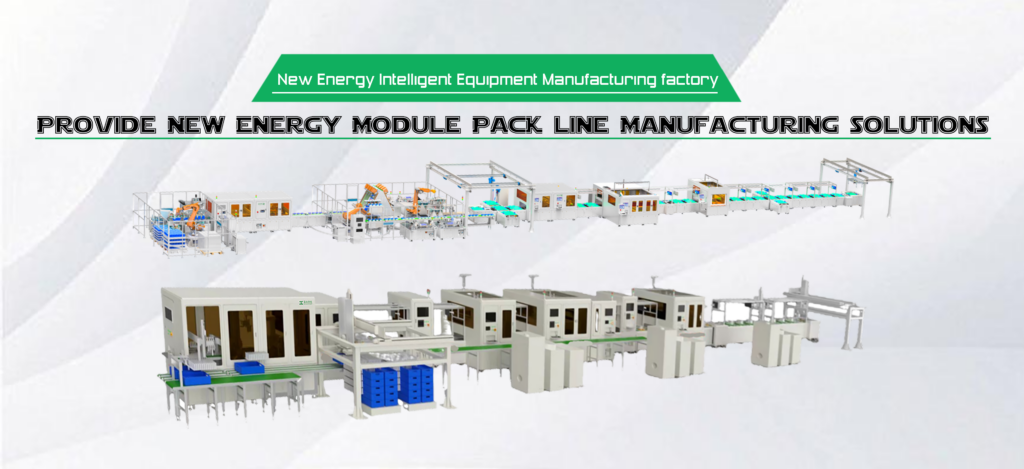
What Is Battery Manufacturing Automation?
Battery manufacturing automation refers to the use of automated machinery, robotics, sensors, control systems, software, and inspection technologies to perform and coordinate battery manufacturing processes.
Instead of relying heavily on manual operations, an automated production line can control many processes with limited human intervention.
Depending on the battery product and production requirements, automation may cover:
- Material loading
- Cell handling
- Cell positioning
- Cell sorting
- Module assembly
- Adhesive application
- Stacking
- Busbar assembly
- Laser welding
- Electrical testing
- EOL testing
- Data collection
- Material transfer
The goal of battery manufacturing automation is not simply to replace workers with machines.
A well-designed automated production system should create a more stable manufacturing process in which equipment, operators, inspection systems, and production data work together.
For battery manufacturers, this can result in higher throughput, improved consistency, better traceability, and a more scalable production environment.
Why Battery Factories Need Automation
The scale and complexity of modern battery manufacturing make automation increasingly important.
The IEA notes that global battery manufacturing capacity remains highly concentrated, with China accounting for more than 80% of global capacity at the end of 2025. The IEA also highlights manufacturing efficiency and automation as important factors behind differences in battery production costs between regions.
For manufacturers entering or expanding the battery industry, several factors are driving the adoption of battery manufacturing automation.
Higher Production Efficiency
Manual assembly can become a bottleneck when production volume increases.
Automated equipment can perform repetitive operations at stable speeds and with consistent positioning.
For example, automated material handling can continuously transfer cells or modules between production stations, reducing unnecessary waiting time between processes.
This allows manufacturers to build production lines that are designed around continuous and coordinated manufacturing rather than isolated manual workstations.
Improved Product Consistency
Battery manufacturing requires precise control.
Small variations in cell positioning, welding, electrical connections, adhesive application, or assembly pressure can affect final product quality.
Automated equipment can execute predefined process parameters consistently.
This is particularly important for manufacturers producing large quantities of battery modules and packs.
The objective of battery manufacturing automation is therefore not only higher output, but also greater process stability.
Reduced Labor Intensity
Battery factories often contain repetitive processes that require significant manual labor.
As production volumes increase, labor requirements can become difficult to scale efficiently.
Automation can reduce the amount of repetitive manual work required for processes such as:
- Material handling
- Cell positioning
- Welding
- Inspection
- Product transfer
This allows operators to focus more on equipment supervision, quality management, maintenance, and production management.
Better Quality Traceability
Modern battery factories increasingly need to know what happened during every stage of production.
Automated systems can collect process information such as:
- Production time
- Equipment status
- Welding parameters
- Inspection results
- Product identification
- Test results
This information can help manufacturers identify quality issues and trace products back to specific production processes.
For high-value battery products, traceability is becoming an important part of intelligent manufacturing.
Key Technologies Driving Battery Manufacturing Automation
Modern battery manufacturing automation is not based on one single technology.
Instead, it combines multiple technologies into an integrated production system.
The most important technologies include robotics, laser processing, intelligent testing, machine vision, automated material handling, and production control systems.
Robot Automation
Robotics is one of the most visible technologies in modern battery factories.
Industrial robots and collaborative automation systems can be used for:
- Cell handling
- Material loading
- Module transfer
- Component positioning
- Product handling
- Palletizing
- Production-line logistics
Robots are particularly valuable for repetitive operations that require high positioning accuracy and stable cycle times.
For example, a robotic handling system can transfer battery modules between different stations while maintaining a consistent production flow.
As battery manufacturing automation develops, robots are increasingly being integrated with vision systems, sensors, conveyors, and production control software.
This creates a more coordinated manufacturing environment rather than simply adding robots to individual machines.
Laser Welding
Laser welding is another important technology in modern battery manufacturing.
Battery modules and packs contain numerous electrical connections that require reliable and precise joining.
Laser welding can be used for applications such as:
- Busbar welding
- Terminal welding
- Electrical connection
- Battery module assembly
Its advantages can include high precision, controlled heat input, repeatable welding parameters, and suitability for automated production.
For this reason, laser welding is often integrated directly into automated battery production lines.
For manufacturers, the key is not simply selecting a laser welding machine, but integrating the welding process with:
- Automatic positioning
- Product handling
- Vision inspection
- Parameter monitoring
- Quality verification
This is where integrated battery manufacturing automation can provide greater value than standalone equipment.
Intelligent Testing Systems
Testing is another critical component of modern battery production.
A battery manufacturing line must verify that products meet defined electrical and quality requirements before they move to the next stage.
Depending on the product, automated testing may include:
- Voltage testing
- Insulation testing
- Resistance testing
- Communication testing
- Functional testing
- EOL testing
End-of-line testing is particularly important because it provides a final verification before the completed product leaves the production process.
Automated testing systems can also record test results and associate them with individual products.
This creates a foundation for digital traceability and intelligent quality management.
From Automated Lines to Smart Factories
The next stage of battery manufacturing automation is the development of the smart factory.
A traditional automated production line focuses primarily on machine operation.
A smart factory goes further by connecting:
Equipment + Data + Software + Quality Control + Production Management
Together, these systems can create a more transparent and responsive manufacturing environment.
What Is a Smart Battery Factory?
A smart battery factory uses connected equipment and digital systems to monitor and optimize production.
A smart factory may collect information from:
- Production equipment
- Sensors
- Testing systems
- Robots
- Manufacturing execution systems
- Quality inspection systems
This data can then be used to monitor production performance and identify potential problems.
For battery manufacturers, smart manufacturing can help answer important questions:
- Which production station is causing a bottleneck?
- Which machine has abnormal downtime?
- Which process is generating more defects?
- How is equipment utilization changing?
- What is the quality status of each product?
The combination of battery manufacturing automation and digital production management is therefore becoming increasingly important.
Future Trends in Battery Manufacturing Automation
The future of battery manufacturing automation will not simply be about adding more machines.
The industry is moving toward more connected, flexible, and data-driven manufacturing systems.
Several trends are particularly important in 2026.
1. More Intelligent Production Lines
Future production lines will increasingly combine robotics, sensors, machine vision, testing systems, and software.
Instead of operating as independent machines, equipment will communicate through an integrated control architecture.
This can improve:
- Production coordination
- Equipment monitoring
- Quality management
- Data visibility
2. Greater Use of Data-Driven Manufacturing
Production data is becoming an increasingly valuable resource.
Manufacturers can use production data to understand:
- Equipment performance
- Process stability
- Defect rates
- Production efficiency
- Maintenance requirements
Over time, data-driven analysis can help manufacturers optimize production processes and reduce unnecessary downtime.
3. More Flexible Automation
Battery technology continues to evolve.
Manufacturers may need to produce different battery configurations, module designs, or pack structures.
This means future battery manufacturing automation systems will need to become more flexible.
Manufacturers should consider:
- Quick changeover
- Modular equipment design
- Flexible material handling
- Programmable process parameters
- Scalable production capacity
Flexible automation can help manufacturers adapt as products and market requirements change.
4. Greater Integration of Inspection and Manufacturing
Quality inspection is increasingly becoming part of the production process rather than a separate final step.
Machine vision, electrical testing, welding inspection, and process monitoring can be integrated directly into automated production lines.
This allows potential quality problems to be detected earlier.
Early detection can reduce the cost of defective products and improve overall production stability.
5. Automation Will Become a Strategic Investment
For battery manufacturers, automation should not be viewed simply as an equipment purchase.
It is increasingly a long-term manufacturing strategy.
The right automation system should consider:
- Current production requirements
- Future capacity expansion
- Product specifications
- Factory layout
- Quality requirements
- Labor availability
- Equipment maintenance
- Data management
The IEA’s 2026 analysis emphasizes that achieving competitive battery manufacturing requires high production yields and increasing levels of automation, particularly as manufacturers seek to improve efficiency and reduce labor intensity.
Jialuo Intelligent Automation Solutions
As battery manufacturing continues to evolve, selecting the right automation partner is becoming increasingly important.
Jialuo Intelligent provides customized automation solutions for battery manufacturers, with a focus on battery module and battery pack production.
Our solutions can include:
- Battery module assembly lines
- Battery pack assembly lines
- CCS assembly solutions
- Automated material handling
- Laser welding systems
- Testing and inspection systems
- Customized battery automation equipment
Rather than offering a one-size-fits-all production line, the automation solution should be designed according to the customer’s:
- Battery cell type
- Module structure
- Pack design
- Production capacity
- Factory layout
- Manufacturing process
- Automation requirements
For manufacturers planning a new battery production project, early engineering coordination can help ensure that equipment, process flow, factory layout, and future expansion requirements are considered together.
Conclusion
The future of battery manufacturing automation is moving from isolated automated machines toward integrated, intelligent, and flexible production systems.
Robotics can improve material handling and repetitive assembly.
Laser welding can provide precise and repeatable electrical connections.
Automated testing can improve quality verification and traceability.
Digital production systems can connect equipment and manufacturing data.
Together, these technologies are creating the foundation for the next generation of smart battery factories.
As global battery manufacturing capacity continues to expand, manufacturing efficiency will become increasingly important. The IEA’s latest analysis shows that global battery manufacturing capacity exceeded 4 TWh at the end of 2025, while production remains highly concentrated geographically.
For battery manufacturers, the question is therefore no longer simply whether to automate.
The more important question is:
How can automation be designed to create a more efficient, flexible, scalable, and reliable battery production system?
That is where the right technology, engineering approach, and automation partner can make a difference.
Build Your Battery Automation Solution with Jialuo Intelligent
Planning a new battery module or battery pack production line?
Jialuo Intelligent can provide customized automation solutions based on your product design, production capacity, and manufacturing process.
Talk to Our Engineering Team
Get A Quote