
A steel strip forming line for battery modules is an automated production system designed to process steel straps used to secure lithium battery cells within a module structure.
In energy storage system (ESS) battery manufacturing, steel straps can help maintain the mechanical stability of the cell group when used as part of a properly designed module structure. Consistent strap dimensions and forming quality are important for reliable assembly and repeatable production.

This guide explains how a battery module steel strip forming line works, which processes it may integrate, the key technical parameters to evaluate, and what manufacturers should confirm before selecting equipment for an ESS or other battery module project.
Why Are Steel Straps Used in Battery Modules?
Battery modules need to maintain their structural integrity throughout manufacturing, transportation, and operation.
Depending on the module design, cells may be secured using end plates, steel straps, structural frames, or a combination of these components. Steel straps can help hold the cell group in position and maintain the required mechanical restraint.
The performance of a steel strap depends on several factors, including:
- Steel material and thickness
- Strap width and formed geometry
- Module dimensions and cell arrangement
- End-plate design and fastening method
- Required clamping force
- Operating and environmental conditions
A properly specified steel strap can contribute to module stability. However, its actual mechanical performance and any potential effect on service life must be validated against the specific module design and operating conditions.
What Does a Steel Strip Forming Line Do?
A steel strip forming line converts raw steel strip into formed components according to the dimensions and geometry required by the battery module.
The exact process sequence depends on the strap design, material, insulation requirements, and production targets. A customized line may integrate the following processes.
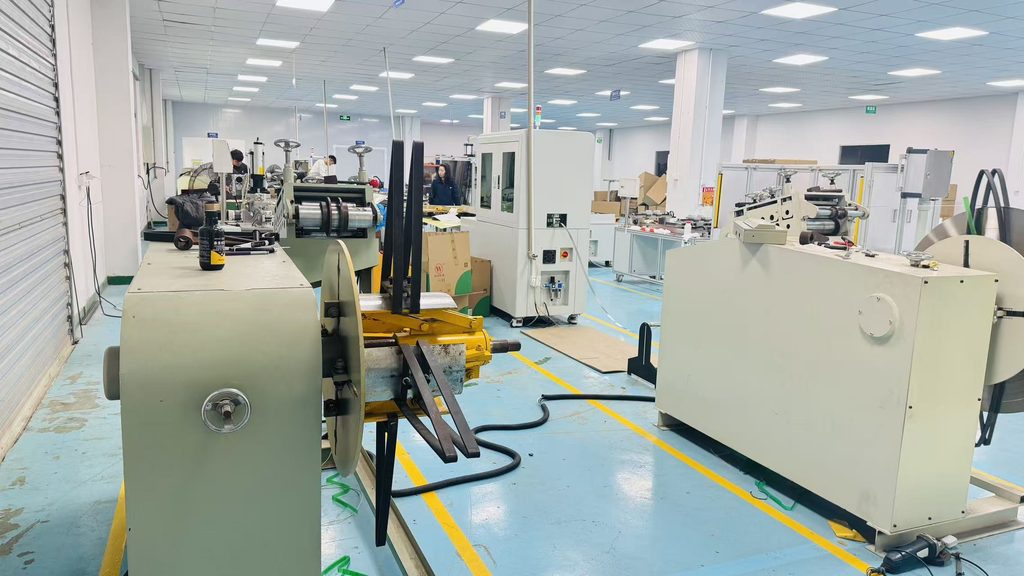
1. Material Uncoiling and Leveling
The steel strip is unwound from a coil and passed through a leveling unit to reduce material curvature and improve feeding consistency.
Stable material feeding helps establish a consistent reference for subsequent punching, cutting, bending, and welding operations.
2. Punching and Cutting
Depending on the product design, the line may punch locating holes and cut the steel strip to the required length.
Hole positions, blank dimensions, and cutting quality should be controlled according to the module drawings to support accurate downstream assembly.
3. Sleeve Insertion and Heat Shrinking
Some steel strap designs require insulating sleeves or protective components at specified positions.
Where required, the line can be configured with sleeve insertion and heat-shrinking stations. These operations depend on the module’s insulation design and should be confirmed during the equipment specification stage.
4. Automatic Bending and Forming
The steel strip is bent into the required contour to match the module structure and end-plate positions.
Bending accuracy is an important consideration because dimensional deviations may affect fit, assembly consistency, and the final position of the strap.
The forming method and tooling should be selected according to the material properties, strip thickness, and required geometry.
5. Welding and Dimensional Inspection
Where the strap design includes welded joints, the line may integrate a suitable welding process.
Welding parameters should be established according to the steel material, thickness, joint structure, and quality requirements.
Dimensional inspection can then verify whether the formed component meets the specified tolerances.
6. Additional Inspection and Testing
Depending on the product and customer requirements, the line may include visual inspection, dimensional measurement, weld inspection, or other quality-control functions.
Electrical insulation or tensile testing should only be included where applicable to the product design and agreed technical requirements.
The inspection scope and acceptance criteria should be defined in the project technical proposal.
Which Technical Parameters Define a Steel Strip Forming Line?
When comparing equipment suppliers, it is important to understand not only the headline specifications but also the conditions under which those specifications apply.
The following parameters are useful starting points for evaluating a battery module steel strip forming line.
Equipment Footprint
For reference, one typical configuration may occupy approximately:
- Length: 25–35 m
- Width: 3 m
- Height: 2.3 m
These dimensions are indicative rather than universal. The actual footprint depends on the process sequence, material path, station layout, safety requirements, and available workshop space.
The final equipment layout should be confirmed before factory planning and installation.
Steel Strip Material Compatibility
For the relevant Jialuo reference configuration, the supported steel strip range is:
- Strip width: 10–30 mm
- Strip thickness: 0.5–2.0 mm
Actual compatibility depends on the steel grade, material properties, surface condition, and forming geometry.
Before finalizing the equipment design, the supplier should verify the required range using the customer’s material specifications and, where necessary, sample material.
Formed Product Dimensions
For reference, one configuration may support formed strap dimensions within the following ranges:
- Formed strap width: 105–540 mm
- Formed strap length: 200–2200 mm
These dimensions refer to the formed product envelope, not the width and thickness of the raw steel strip.
The final compatible product range should be confirmed against the customer’s module drawings and forming requirements.
Feeding Speed and Forming Accuracy
One reference configuration may provide the following performance parameters:
| Parameter | Reference value |
|---|---|
| Feeding speed | 0–400 mm/s |
| Feeding positioning accuracy | Approximately ±0.2 mm |
| Bending accuracy | Approximately ±0.1° |
These figures apply to a specific equipment configuration. Actual performance depends on the material, product geometry, tooling, process settings, and measurement method.
The final specifications should be agreed upon in the technical proposal and equipment acceptance criteria.
What Makes a Steel Strip Forming Line Flexible?
A production line may need to support several strap dimensions or module variants over its service life. Flexibility should therefore be evaluated alongside production speed and forming accuracy.
Material Range
The supported material range determines which steel strip specifications the line can process.
A wider range should not be assumed to be automatically achievable. Different material grades, thicknesses, and forming characteristics may require adjustments to tooling or process parameters.
Module Size Adaptability
Different module designs may require different strap lengths, contours, and end-plate positions.
Adjustable tooling and programmable parameters can help accommodate product variants, provided the mechanical design supports the required range.
Before ordering, confirm which product dimensions can be supported and whether additional tooling is needed.
Changeover Time
Changeover time affects how efficiently a line can switch between product variants.
The actual changeover procedure may involve tooling adjustments, fixture replacement, parameter selection, or verification of the first finished parts.
If several module designs will share one production line, ask the supplier to define the changeover procedure and expected time for the specific product range.
How Can Steel Strapping Support Module Reliability?
Steel strapping can help restrain the cell group and reduce unwanted relative movement when it is properly integrated into the module structure.
However, module reliability depends on the complete mechanical design, not on the steel strap alone.
Material selection, strap geometry, fastening method, end-plate design, cell arrangement, and the required clamping force should be evaluated together.
The forming line’s role is to manufacture straps that consistently meet the required dimensions and quality standards. Actual module performance should be validated through the customer’s mechanical and reliability testing.
Where Are Steel Strip Forming Lines Used?
Energy Storage Systems (ESS)
ESS battery modules may require consistent mechanical restraint and repeatable assembly across large production volumes.
A steel strip forming line can support manufacturing where the module design uses steel straps as part of its structural fixation system.
Electric Vehicle Battery Modules
EV battery module designs vary according to vehicle architecture, cell format, and structural requirements.
The forming equipment should be configured for the specific strap geometry, production capacity, and quality standards required by the application.
Industrial and Specialty Battery Systems
Industrial and specialty battery systems may also use steel straps where the module design requires mechanical fixation.
The appropriate equipment configuration depends on the product structure, expected output, and required inspection processes.
What Should You Confirm Before Ordering a Steel Strip Forming Line?
Before requesting a quotation, prepare the technical information needed to define the production-line configuration.
1. Module Structure and Product Drawings
Provide the module dimensions, cell arrangement, end-plate design, strap routing, and required formed strap geometry.
These details determine the tooling, forming sequence, and compatible product range.
2. Material Specifications
Confirm the steel grade, strip width, thickness, surface condition, and material properties.
These specifications help the supplier evaluate feeding stability, forming requirements, and suitable process parameters.
3. Production Capacity and Cycle Time
Define the target output and expected operating schedule.
The achievable production rate depends on the strap geometry, process sequence, bending cycle, welding requirements, inspection scope, and equipment configuration.
Ask for the expected cycle time under the conditions applicable to your product.
4. Inspection and Acceptance Criteria
Specify the required dimensional tolerances, welding quality criteria, inspection methods, and other applicable tests.
It is important to distinguish between the inspection functions included in the equipment and the acceptance standards used to evaluate finished parts.
5. Data Traceability and MES
If the factory requires digital production records, confirm which parameters and inspection results must be collected.
The proposal should identify the required data fields, product identification method, storage requirements, and MES or other system interfaces.
6. Installation and Commissioning
Confirm the supplier’s responsibilities for factory pre-commissioning, transportation preparation, on-site installation, commissioning, and operator training.
The project schedule should reflect the equipment scope, site readiness, and agreed acceptance requirements.
Key Takeaways
When selecting a steel strip forming line for battery modules, focus on the following points:
- Material compatibility: Confirm the steel grade, strip width, and thickness.
- Product dimensions: Check the required strap length, width, and forming geometry.
- Process configuration: Define the necessary uncoiling, leveling, cutting, bending, welding, and inspection operations.
- Accuracy: Confirm feeding and bending tolerances under specified operating conditions.
- Flexibility: Evaluate the tooling and changeover procedure for planned product variants.
- Quality control: Define inspection scope and acceptance criteria.
- Project support: Confirm commissioning, training, and after-sales responsibilities.
Because steel strip forming equipment is commonly customized to the product, the final configuration should be based on the customer’s drawings, material specifications, production targets, and quality requirements.
Frequently Asked Questions
Is Steel Strapping the Same as a Busbar?
No. A busbar is an electrical conductor designed to carry current. Steel strapping is a structural component used to help secure the battery module.
They serve different functions, although both may be present in the same module.
Why Is Steel Strapping Used in Battery Modules?
Steel strapping can help hold cells in position and provide mechanical restraint as part of the module structure.
Its dimensions, material, and fastening method should be selected according to the module design and validated against the relevant mechanical requirements.
Can One Steel Strip Forming Line Handle Different Strap Dimensions?
Potentially, yes. The achievable range depends on the equipment’s mechanical design, tooling, material compatibility, and control system.
Some product changes may require only parameter adjustments, while others may require tooling changes or additional engineering work.
The supported product range and changeover procedure should be confirmed before ordering.
What Inspection Functions Can Be Integrated?
Depending on the product and technical requirements, a line may include dimensional measurement, visual inspection, weld inspection, and other specified tests.
Insulation or tensile testing should be included where applicable to the product design and agreed inspection plan.
The exact configuration should be defined in the technical proposal.
Is Installation and Commissioning Available?
Jialuo Intelligent provides installation and commissioning support through engineers and technical personnel.
Equipment is pre-commissioned at the Shenzhen facility before shipment. For overseas projects, interpretation support can also be arranged to facilitate communication between the engineering team and the customer’s local team.
The actual schedule depends on the project scope, equipment configuration, site conditions, and agreed implementation plan.
How Should Reference Parameters Be Used?
Reference parameters describe a particular equipment configuration and should not be treated as universal performance guarantees.
Actual feeding speed, forming accuracy, production capacity, and inspection capability depend on the customer’s material, strap geometry, process requirements, and acceptance criteria.
The final specifications should be confirmed in the project technical proposal.
About Jialuo Intelligent
Shenzhen Jialuo Intelligent Technology Co., Ltd. develops intelligent equipment and production-line solutions for lithium battery manufacturing.
Founded in 2008, Jialuo Intelligent has focused on intelligent equipment for the new energy and lithium battery industry since 2019.
Our product portfolio includes:
- Battery Module PACK Production Lines
- Battery Module Steel Strap Forming Lines
- CCS Automated Production Lines
- Prismatic Cell Cover Plate Assembly and Welding Equipment
- Battery Module Testing Solutions
- Customized Lithium Battery Automation Equipment
Our engineering capabilities cover mechanical design, automation control, equipment integration, production-line commissioning, and customized manufacturing solutions.
Equipment configurations are developed according to each customer’s product drawings, process route, production capacity, and quality requirements.
Planning a Steel Strip Forming Line for Battery Modules?
Every steel strap project starts with a specific module design.
To help evaluate the appropriate production-line configuration, prepare the following information:
- Steel strip material and dimensions
- Formed strap drawings
- Battery module dimensions
- Target production capacity
- Required forming and welding processes
- Inspection and traceability requirements
With these details, our engineering team can assess the process route and develop a steel strip forming line solution based on your product structure and production requirements.
Shenzhen Jialuo Intelligent Technology Co., Ltd.
Address: Room 101, Building 2, No. 8, Chengguang Industrial Park, Kukeng, Dafu Community, Guanlan Street, Longhua District, Shenzhen, China
Email: jch@cnjialuo.com
WhatsApp: +86 181 2473 5015
Jialuo Intelligent | Battery Automation Solutions