
As energy storage systems become an increasingly important part of the global energy infrastructure, manufacturers are paying closer attention to battery module design, production efficiency, quality control, and long-term reliability.
Energy storage system (ESS) battery modules share some manufacturing processes with electric vehicle (EV) battery modules. However, their requirements can differ in cell configuration, structural design, thermal management, serviceability, and production testing.
For manufacturers planning a new energy storage battery production facility, these differences directly affect equipment selection and production-line configuration.
This article explores key considerations shaping ESS battery module manufacturing in 2026, including large-format cells, thermal management, automation, electrical connections, quality testing, and traceability. It also explains what buyers should prepare before selecting an ESS battery module production line.
Shenzhen Jialuo Intelligent Technology Co., Ltd. develops battery module PACK production lines, battery module steel strap forming lines, CCS automated production lines, and customized lithium battery automation equipment for different manufacturing requirements.
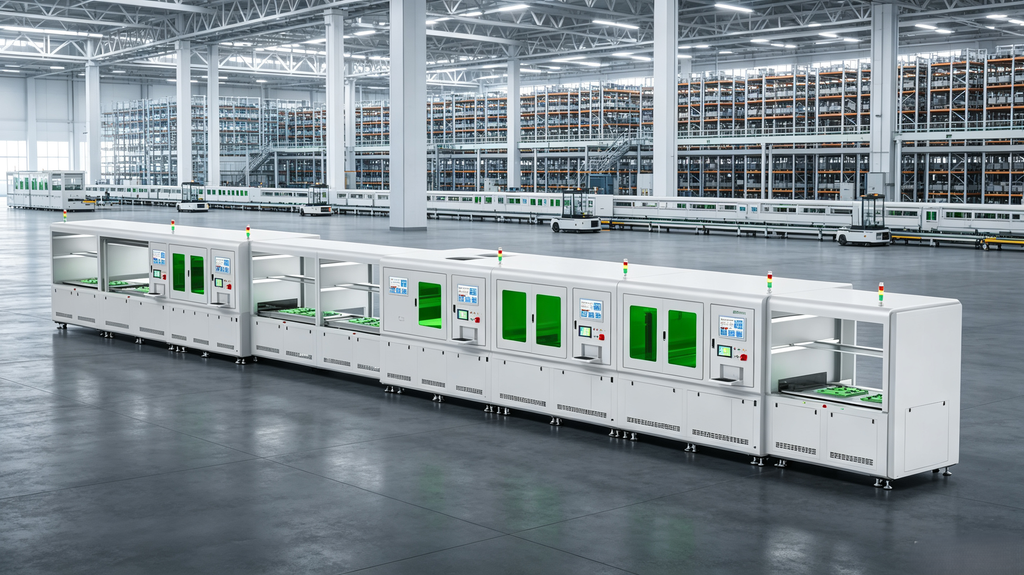
1. How Does ESS Battery Module Manufacturing Differ from EV Battery Manufacturing?
ESS and EV battery modules may share processes such as cell positioning, electrical connection, structural assembly, and testing. However, the final product requirements are not necessarily the same.
Stationary energy storage products are designed around their intended application, operating conditions, system architecture, and maintenance strategy. These factors influence both module design and manufacturing processes.
Large-Format Cells and Handling Requirements
Large-format prismatic cells are widely used in stationary energy storage applications. Compared with smaller cells, a module built around large-format cells may involve fewer individual cell positions, but each cell can be heavier and more difficult to handle.
This changes the requirements for material transfer and assembly.
Depending on cell weight and module structure, manufacturers may need:
- Assisted cell loading and positioning
- Controlled alignment during stacking or assembly
- Ergonomic handling solutions
- Stable transfer mechanisms between workstations
- Fixtures designed for the specific cell and module dimensions
The appropriate handling method depends on cell weight, production volume, plant layout, and the level of automation required.
Module Structure and Safety Requirements
Module design affects cell spacing, insulation, structural support, electrical connections, and access for maintenance.
For equipment manufacturers, these design details determine the necessary fixtures, assembly sequence, inspection stations, and safety provisions.
Rather than adapting a standard production-line layout without modification, manufacturers should define equipment requirements according to the actual module drawings and manufacturing process.
Long-Term Reliability and Quality Control
Stationary storage products are often designed for extended service periods. Reliability requirements can influence connection quality, structural integrity, insulation performance, and the verification procedures used during production.
The appropriate inspection scope depends on the product specification and applicable requirements. It should be defined before equipment design begins so that the necessary testing functions can be integrated into the production line.
2. Which Cell Formats and Module Architectures Should Buyers Consider?
Cell format is one of the first decisions that affects ESS battery module equipment selection.
Prismatic, cylindrical, and pouch cells have different mechanical characteristics and assembly requirements. A production line should be designed around the selected format rather than assuming that all cell types can share the same fixtures and processes.
Prismatic Battery Module Production
Prismatic cells are commonly used in energy storage products because their rigid housings support compact module arrangements.
Depending on the design, manufacturing may involve:
- Cell loading and positioning
- Cell alignment and stacking
- Compression or structural assembly
- Busbar or other electrical connection processes
- Insulation and protection component installation
- Electrical testing and final inspection
The required stations depend on the module architecture, joining method, and customer quality standards.
For manufacturers using large-format prismatic cells, handling capability, fixture accuracy, and access to electrical connection points should be considered early in the equipment design process.
Cell-to-Pack and Integrated Designs
Cell-to-pack (CTP) and other integrated architectures reduce or change the role of traditional module structures. Their manufacturing processes can differ from conventional module-based designs.
These architectures may reduce certain components or assembly steps, but they can also shift structural, electrical, and testing requirements to different stages of production.
Before selecting equipment, buyers should clarify whether the project involves conventional modules, integrated cell-to-pack structures, or a customized arrangement. This distinction affects the production process, equipment layout, tooling, and inspection strategy.
Battery Chemistry and Process Requirements
Lithium iron phosphate (LFP) cells are widely used in stationary energy storage applications. However, chemistry alone does not determine the production-line configuration.
Cell dimensions, terminal design, connection method, module structure, insulation requirements, and the intended application are all relevant to equipment selection.
The supplier should review the actual cell and module specifications rather than selecting equipment based only on battery chemistry.
3. How Does Thermal Management Affect ESS Module Production?
Thermal management is an important part of energy storage product design. The chosen cooling method affects module structure, component integration, assembly sequence, and testing requirements.
Liquid Cooling and Cooling Plate Integration
Some energy storage designs use liquid cooling to manage operating temperatures. Depending on the architecture, cooling plates, coolant connections, seals, and associated components may need to be integrated during module or system assembly.
These components can introduce additional manufacturing requirements, including:
- Accurate positioning of cooling components
- Controlled fastening and assembly
- Installation of coolant connections and seals
- Leak testing where required by the design
- Inspection of interfaces and assembly quality
Not every ESS module uses the same cooling architecture. The production process should follow the customer’s approved design and test requirements.
Air Cooling and Other Thermal Designs
Other products may use air cooling or different thermal management arrangements.
The equipment supplier should understand which components are installed at the module manufacturing stage and which are assembled later at the battery pack or system level.
This distinction helps prevent unnecessary stations from being included in the production line and ensures that required processes are assigned to the correct stage.
What Buyers Should Provide
When requesting a quotation for an ESS battery module production line, buyers should provide available thermal management drawings, component specifications, assembly instructions, and testing requirements.
If these details are still under development, the preliminary scope should clearly identify which assumptions may affect the final equipment configuration.
4. What Role Does Automation Play in ESS Battery Module Assembly?
Automation can improve process consistency, reduce repetitive manual work, and support more controlled material handling. However, the appropriate level of automation depends on production volume, product variety, labor availability, investment budget, and the manufacturer’s expansion plans.
Handling Heavy Cells and Modules
Large cells and assembled modules may require handling assistance to reduce manual lifting and improve positioning consistency.
Possible solutions include assisted lifting devices, transfer conveyors, positioning mechanisms, and automated handling systems.
The choice depends on cell weight, workstation arrangement, required throughput, and the degree of operator involvement.
For projects with relatively low initial output, a semi-automatic configuration may be more appropriate than a fully automated line. Higher-volume projects may justify additional automatic loading, transfer, assembly, and inspection functions.
Electrical Connection and Joining Processes
Electrical connections are critical to module performance and reliability. Depending on the product design, manufacturers may use laser welding, resistance welding, mechanical fastening, or other specified connection methods.
The selected process affects equipment configuration, tooling, parameter control, inspection methods, and acceptance criteria.
For example, a CCS automated production line may integrate processes such as busbar laser welding, FPC pulse hot riveting, electrical testing, and vision inspection, depending on the customer’s design.
A CCS line and a battery module PACK line perform different functions. The equipment scope should clearly identify whether CCS components are manufactured separately, integrated into the module assembly process, or supplied as a prepared component for downstream installation.
Flexible Production and Changeover
Manufacturers introducing multiple module models should consider product changeover during the initial equipment design.
Relevant factors include:
- Differences in cell dimensions and module structure
- Fixture and tooling requirements
- Changes in electrical connection positions
- Different process parameters
- Inspection and testing requirements
- Product recipes and traceability settings
Compatible product models may share equipment or fixtures, but compatibility must be confirmed through engineering review. Different cell formats or fundamentally different module structures may require substantial changes to tooling and process configuration.
5. Why Are Testing and Traceability Important?
A production line should not only assemble a module. It should also support the inspections and records required to verify that the finished product meets the agreed specification.
Electrical Testing
Depending on the product and manufacturing stage, testing may include open-circuit voltage (OCV), internal resistance, insulation resistance, dielectric withstand testing, connection verification, or communication checks.
Not every test is appropriate for every station or module design. The required test items, limits, test sequence, and handling of failed products should be specified by the customer and confirmed during process planning.
Connection Quality and Process Monitoring
For welded or mechanically connected components, manufacturers may need to verify connection quality through suitable inspection and testing methods.
The appropriate approach depends on the joining technology and product requirements. Process monitoring, visual inspection, electrical measurements, and other verification methods may be used where applicable.
The equipment proposal should identify which inspections are integrated into the line and which remain separate quality-control activities.
Data Collection and Traceability
Traceability can help manufacturers connect production records with individual modules or batches.
Depending on the customer’s requirements, the system may record:
- Product serial numbers
- Cell or material identification
- Process parameters
- Inspection and test results
- Equipment alarms and production status
- Rework or quality records
The required level of traceability varies by application. Buyers should define data fields, storage requirements, barcode or code-reading methods, and any MES integration needs before finalizing the equipment specification.
6. Which Standards and Compliance Requirements Should ESS Buyers Review?
Battery product standards and machinery safety requirements address different aspects of a project. Buyers should distinguish requirements for the battery or energy storage system from requirements for the equipment used to manufacture it.
Depending on the product, application, and destination market, standards such as UL 1973 or IEC 63056 may be relevant to stationary battery products or energy storage applications.
These standards do not automatically establish the conformity requirements for the manufacturing equipment itself.
For the production line, buyers should separately confirm the applicable machinery safety, electrical safety, and market access requirements for the destination country.
Before the equipment design is finalized, the buyer and supplier should clarify:
- The destination market and installation location
- Applicable customer and regulatory requirements
- The equipment’s electrical and safety documentation
- Required testing and inspection records
- Factory acceptance and site acceptance criteria
- Required technical documentation and language
Early clarification helps the engineering team plan the equipment configuration and documentation scope more accurately.
7. What Should Buyers Prepare Before Selecting an ESS Battery Module Production Line?
A clear technical brief helps equipment suppliers evaluate the process and prepare a realistic proposal.
Product Information
Provide the cell format, cell dimensions, module drawings, module weight, electrical connection design, and available assembly specifications.
If the product design is not finalized, identify the current version and any anticipated changes.
Production Targets
Clarify the target output per shift, annual production volume, planned shifts, and expected future expansion.
These details help determine whether a semi-automatic, partially automated, or highly automated solution is appropriate.
Process and Quality Requirements
List the required assembly operations, joining methods, testing items, inspection criteria, and traceability expectations.
Also identify which processes must be integrated into the line and which can remain separate.
Plant Layout and Utilities
Provide the available workshop dimensions, layout drawings, material flow requirements, and relevant utility information.
The equipment layout should account for operator access, maintenance clearance, material storage, safety provisions, and future expansion where required.
Budget and Expansion Plans
The lowest initial investment is not always the most suitable long-term option. Buyers should compare equipment scope, labor requirements, expected output, product flexibility, and future upgrade needs.
A phased automation strategy may be appropriate when production is starting at a relatively low volume and is expected to expand later.
Frequently Asked Questions
Can a Battery Module PACK Line Be Used for ESS Battery Modules?
Potentially, yes. The suitability depends on the cell format, module structure, joining methods, handling requirements, testing scope, and target output.
A line designed for one application should not be assumed to support a different ESS product without an engineering review.
Are ESS Battery Module Lines Always Fully Automated?
No. The appropriate automation level depends on production volume, product complexity, investment budget, labor conditions, and future expansion plans.
Semi-automatic lines can be suitable for some initial manufacturing projects, while higher-volume production may justify additional automated handling, assembly, and testing functions.
Does Every ESS Module Require Liquid Cooling?
No. Thermal management depends on the battery and system design. Some products use liquid cooling, while others use air cooling or different arrangements.
The manufacturing equipment should be configured according to the approved product design.
What Testing Should Be Included in an ESS Module Production Line?
The required tests depend on the product specification and quality plan. Possible items include OCV, internal resistance, insulation testing, connection verification, and BMS communication checks.
The final testing scope should be confirmed with the customer rather than assumed to be identical for all ESS products.
How Is Installation and Commissioning Arranged?
Jialuo Intelligent’s project process includes equipment pre-commissioning in Shenzhen before shipment, followed by installation and commissioning at the customer’s site according to the agreed scope.
As indicative planning references, domestic installation and commissioning for steel strap forming lines may take approximately 7–10 days, while other battery module production lines may require around 30 days. Overseas implementation may take around one month for suitable configurations.
These are reference durations, not guaranteed lead times. Actual schedules depend on equipment complexity, site readiness, utilities, logistics, and the agreed acceptance procedure.
Key Takeaways
ESS battery module manufacturing requires equipment designed around the actual product architecture, process requirements, and quality standards.
- Large-format cells can increase handling and positioning requirements.
- Thermal management components may introduce additional assembly and testing steps.
- Automation should match production volume, product variety, and investment plans.
- Electrical connections, inspection, and traceability should be defined during process planning.
- Battery product standards and manufacturing equipment safety requirements must be assessed separately.
- Clear product drawings, output targets, plant layouts, and testing requirements help suppliers prepare more accurate equipment proposals.
About Jialuo Intelligent
Shenzhen Jialuo Intelligent Technology Co., Ltd. develops intelligent equipment and production-line solutions for lithium battery manufacturing.
Our product portfolio includes:
- Battery Module PACK Production Lines
- Battery Module Steel Strap Forming Lines
- CCS Automated Production Lines
- Prismatic Cell Cover Plate Assembly and Welding Equipment
- Battery Module Testing Solutions
- Customized Lithium Battery Automation Equipment
Founded in 2008, Jialuo Intelligent has focused on intelligent equipment for the new energy and lithium battery industry since 2019. Our engineering capabilities cover mechanical design, automation control, equipment integration, line commissioning, and customized manufacturing solutions.
Planning an ESS Battery Module Manufacturing Project?
Every energy storage project has its own cell specifications, module architecture, production targets, and quality requirements.
If you are planning a new ESS battery module production line or evaluating equipment for an existing manufacturing facility, share your product drawings, process requirements, target capacity, and plant layout with our engineering team.
Jialuo Intelligent can evaluate the manufacturing process and develop a customized battery module production solution based on your product structure, production goals, and inspection requirements.
Shenzhen Jialuo Intelligent Technology Co., Ltd.
Room 101, Building 2, No. 8, Chengguang Industrial Park, Kukeng, Dafu Community, Guanlan Street, Longhua District, Shenzhen, China
Email: jch@cnjialuo.com
WhatsApp: +86 181 2473 5015
Jialuo Intelligent | Battery Automation Solutions