
Blue film wrapping is often treated as a simple packaging operation in battery manufacturing.
For prismatic battery cells, however, it serves a much more important purpose: electrical insulation and surface protection before module assembly.
The film helps separate the cell’s aluminum casing from nearby conductive components, including module frames, busbars, fixtures, and neighboring cells. Inadequate coverage, wrinkles, lifted edges, or exposed areas may create problems during handling and downstream assembly.
This is why choosing between manual wrapping and a semi-automatic blue film wrapping machine is not simply a question of production speed.
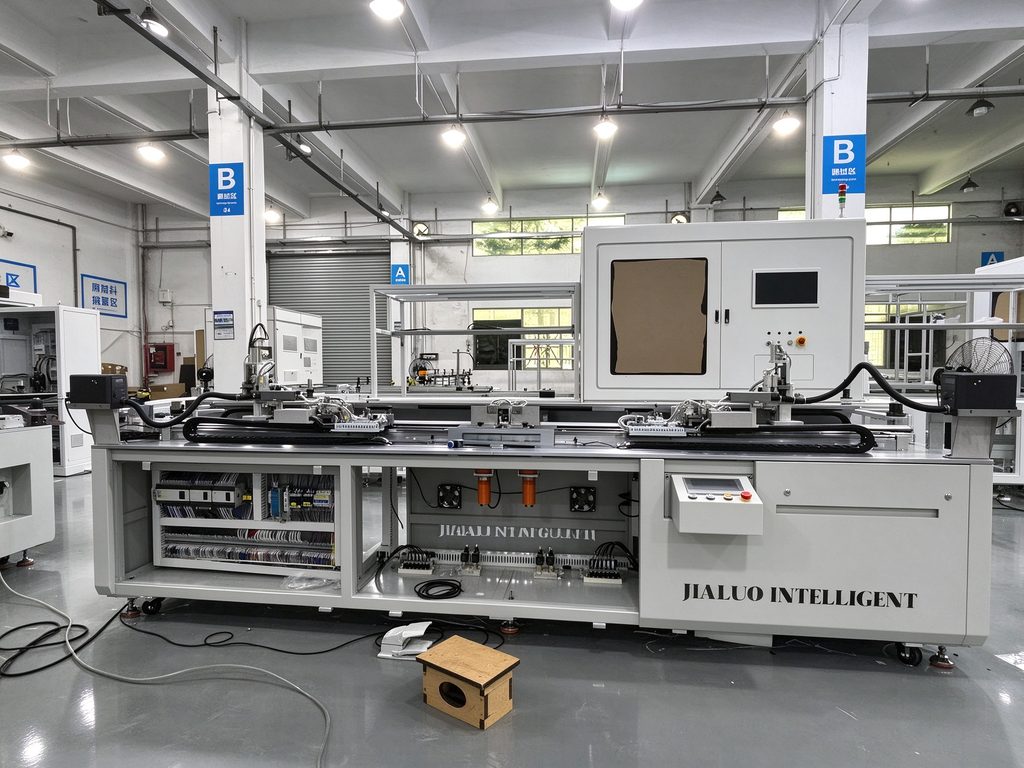
It is also about wrapping consistency, corner coverage, film tension, changeover flexibility, and the amount of variation introduced by manual operation.
This article explains the purpose of blue film wrapping, which areas of a prismatic cell need protection, when manual wrapping is still practical, and what buyers should evaluate before selecting a semi-automatic wrapping machine.
A semi-automatic wrapper does not eliminate the operator. It automates the repetitive parts of the wrapping process so that the operator can focus on loading, inspection, and exceptions.
What Does Blue Film Wrapping Protect on a Prismatic Cell?
Blue film wrapping performs several functions during prismatic battery cell manufacturing and module assembly.
1. Electrical Insulation
Electrical insulation is one of the primary reasons for applying blue film to prismatic cells.
The aluminum cell casing may be electrically connected to an electrode, depending on the cell design. During module assembly, the casing may come close to conductive components such as module frames, fixtures, or neighboring cells.
The insulating film helps reduce the risk of unintended electrical contact between the cell casing and surrounding components.
The required insulation performance, film thickness, and coverage area should be defined by the cell design and the module insulation requirements.
2. Surface Protection
The film also helps protect the cell casing from scratches, abrasion, and other surface damage during handling, transportation, and assembly.
This is particularly relevant when cells move through multiple production stages before entering the module.
3. Protection Against Environmental Contamination
Depending on the film material and adhesive grade, the wrapping layer may provide some protection against dust or surface contamination.
However, blue film should not automatically be treated as a moisture-proof or sealing material. Any specific environmental protection requirement needs to be confirmed against the film manufacturer’s specifications.
4. Identification and Traceability
Some battery manufacturing processes use labels or printed information on the wrapped cell surface.
These may support product identification, barcode reading, and production traceability.
The first two functions—electrical insulation and surface protection—are generally the most relevant when specifying a blue film wrapping process for prismatic cells.
Which Areas of a Prismatic Cell Need to Be Covered?
A prismatic cell has several surfaces that may require insulation or protection depending on the module structure.
These commonly include:
- Wide faces: The large surfaces that may face neighboring cells.
- Narrow faces: The side surfaces that may face the module frame or end plates.
- Bottom area: The surface that may contact the module base or a thermal interface.
- Top perimeter area: The relevant casing areas around the terminal region, according to the cell and module design.
The terminal surfaces and electrical connection points must remain accessible as required by the module design. Blue film should not cover areas where electrical connections, sensing components, or other interfaces need to be installed.
The wide and narrow faces are generally easier to wrap manually because they provide relatively flat surfaces.
The bottom and top perimeter areas can be more difficult. Film must pass around edges and corners while maintaining suitable tension and adhesion.
Corners deserve particular attention.
Film may wrinkle, lift, fold, or become uneven when it changes direction around an edge. A wrap that looks acceptable on a flat surface may still have an exposed area or lifted edge at a corner.
A consistent wrap is not just about covering the flat surfaces. Edge transitions and corner conditions also need to meet the insulation requirements.
When Is Manual Blue Film Wrapping Still Practical?
Manual wrapping remains a reasonable option for certain production environments.
Automation is not necessarily the best investment for every battery plant.
1. Low Production Volume and Frequent Model Changes
When a factory handles small batches across several cell formats, manual wrapping may be more flexible.
An operator can adjust the wrapping method for a different cell size without requiring a machine setup or tooling adjustment.
For pilot production, small orders, or frequent product development changes, this flexibility may be more valuable than a higher machine output.
2. Repair and Rework Operations
Cells returned from module disassembly or repair may have different surface conditions.
Old film, adhesive residue, and partial wrapping may need to be removed before a new layer is applied.
Manual operation allows the worker to assess the surface and decide how much cleaning or preparation is required.
These irregular tasks may be difficult to handle with a fixed automated sequence.
3. Pilot Production and Sample Builds
During product development and pre-production, manufacturers may only need to wrap a limited number of cells.
At this stage, the priority may be to prepare samples and validate the module structure rather than establish a high-speed, repeatable wrapping process.
Manual wrapping can therefore be a practical starting point.
4. Where Manual Wrapping Starts to Become a Bottleneck
Manual wrapping becomes more difficult to manage when several conditions appear together:
- Daily cell volume increases.
- More operators are assigned to the same process.
- Wrapping acceptance criteria become stricter.
- Downstream module assembly requires more consistent cell dimensions and surface coverage.
Different operators may apply different film tensions, overlap lengths, and wrapping sequences.
Even when individual cells pass visual inspection, variation in film application may create differences at the edges and corners.
These differences should be evaluated against the module’s stacking, compression, and insulation requirements.
When manual variation begins to affect production consistency or labor efficiency, a semi-automatic wrapper becomes worth evaluating.
What Does a Semi-Automatic Blue Film Wrapping Machine Automate?
A semi-automatic wrapper keeps the operator involved but takes over the repetitive wrapping sequence.
A typical process may work as follows:
- The operator loads and positions the prismatic cell.
- The machine feeds the blue film.
- The wrapping mechanism applies the film according to the configured path.
- Film tension and wrapping motion are controlled during the process.
- The film is cut at the required position.
- The operator unloads the cell and checks the wrapping result.
The exact sequence depends on the machine design and the required coverage.
1. More Consistent Film Application
A semi-automatic machine can control the film feeding and wrapping sequence more consistently than manual operation.
This helps reduce variation caused by differences in operator technique.
Film tension, overlap, and positioning should be configured according to the cell dimensions and film characteristics.
2. More Stable Process Time
Manual wrapping speed depends heavily on the operator’s working pace and experience.
A semi-automatic machine provides a more defined machine cycle, making production planning easier.
However, the complete station output must also account for loading, unloading, inspection, and rework.
3. Greater Control Over Wrapping Conditions
A machine can use controlled film feeding and programmed movement to produce a repeatable wrapping sequence.
This is particularly useful when the same cell model is processed repeatedly.
The actual improvement in wrapping quality should be verified using production samples and the agreed acceptance criteria.
4. Model Changeover Flexibility
One important question when evaluating a semi-automatic wrapper is whether different cell formats require new tooling.
A machine with adjustable film paths and programmable movement may accommodate multiple cell formats without replacing dedicated fixtures.
However, this depends on the cell dimensions, geometry, and machine design.
Buyers should confirm which formats are supported, what adjustments are required, and how long a changeover takes.
5. The Operator Still Has an Important Role
Semi-automatic does not mean fully unattended.
The operator generally remains responsible for:
- Loading and positioning cells
- Unloading finished cells
- Checking wrapping appearance
- Identifying lifted edges or other visible defects
- Handling cells that require rework
The machine controls the repetitive process, while the operator handles material flow and exceptions.
The machine repeats the wrapping sequence. The operator checks whether the result meets the required standard.
Why Do Corners Matter So Much in Blue Film Wrapping?
Corners are among the areas that require the most attention during film application.
When film moves from one surface to another, its direction changes. The film must maintain suitable contact and adhesion around the edge without creating excessive wrinkles or exposed areas.
Three factors are particularly important:
Film tension
Insufficient tension may result in loose film or wrinkles. Excessive tension may cause uneven application or stress the film around corners.
Film adhesion
The adhesive must maintain contact with the cell surface under the conditions specified for the application.
Cell geometry
A flat edge, rounded corner, curved surface, or recessed area may require a different wrapping approach.
For cells with curved surfaces or slight recesses, a compliant pressing element may follow the contour more effectively than a rigid roller.
However, the suitability of the pressing mechanism depends on the actual cell geometry and film material.
For this reason, buyers should provide cell samples or detailed drawings when evaluating a wrapping machine.
What Should Buyers Measure Before Choosing a Blue Film Wrapping Machine?
A machine should be evaluated against the actual production process, not only its advertised speed.
The following factors are particularly useful.
1. Cycle Time per Cell
Confirm the expected number of cells processed per minute under the required configuration.
Ask whether the quoted figure includes only the machine’s wrapping cycle or also accounts for loading and unloading.
2. Wrapping Quality and Rework Rate
Define the acceptance criteria for a finished cell.
These may include:
- Required coverage area
- Film overlap
- Wrinkle limits
- Corner and edge adhesion
- Exposed-area limits
- Film positioning
The rework rate should be measured using these defined criteria rather than treated as an undefined equipment failure rate.
3. Changeover Time
Confirm how the machine handles different cell formats.
Ask whether a changeover requires new fixtures, mechanical adjustments, film-path changes, or software parameter updates.
4. Floor Space and Utilities
Check the equipment footprint, power supply, compressed-air requirements, and other site conditions.
A machine that requires additional utilities or substantial layout changes may involve costs beyond its purchase price.
5. Integration with the Production Line
A standalone wrapper may achieve its target speed, but that does not automatically mean it will match the output of the complete module production line.
Consider the cycle times of upstream and downstream stations, buffer capacity, and material transfer arrangements.
Line balancing should be reviewed before the equipment is purchased.
Machine throughput describes the equipment’s processing rate. Net station output describes what the production process can actually deliver.
What Does a Typical Semi-Automatic Blue Film Wrapper Specification Cover?
The following figures are reference values from a typical configuration. Actual specifications may vary according to cell dimensions, film material, adhesive grade, and equipment integration requirements.
| Parameter | Reference specification |
|---|---|
| Throughput | Approximately 4–6 PPM |
| Power supply | 380V ±10%, 3-phase, 5-wire |
| Power consumption | Approximately 5 kW |
| Operating temperature | -10°C to 45°C |
| Model changeover | No fixture change required in most reference configurations |
These figures should be treated as preliminary selection references rather than universal guarantees.
In particular:
- Throughput: Actual output depends on cell size, wrapping sequence, loading and unloading time, and inspection requirements.
- Power supply: The electrical configuration should be checked against the customer’s factory supply.
- Power consumption: The actual requirement should be confirmed in the equipment specification.
- Operating temperature: The film and adhesive manufacturer’s recommended operating conditions should also be considered.
- Model changeover: Compatibility with different cell formats must be verified against the actual dimensions and machine configuration.
Any equipment failure-rate or wrapping defect-rate target should be defined separately, with a clear measurement method and acceptance standard.
Is a Semi-Automatic Wrapper Always the Right Choice?
No. The decision depends on production volume, cell format stability, labor availability, and quality requirements.
A factory processing a relatively small number of cells across several different formats may find manual wrapping sufficient.
A plant handling repair and rework operations may also benefit from the flexibility of manual work.
However, when production volume increases and consistent wrapping becomes more important, a semi-automatic machine may provide a better balance between labor input and process repeatability.
The purpose is not simply to replace manual labor. It is to move repetitive operations into a controlled process while allowing operators to focus on loading, inspection, and exceptions.
Frequently Asked Questions About Prismatic Cell Blue Film Wrapping
Can a semi-automatic wrapper handle cells with curved surfaces or slight recesses?
It may be possible, depending on the cell geometry and machine design.
A compliant pressing element may follow a curved contour more effectively than a rigid roller. The result should be verified using actual cell samples and the specified film material.
Does changing the cell model require new fixtures?
Not necessarily.
Some configurations use adjustable film paths and programmable movements to accommodate different cell formats without fixture replacement.
However, compatibility should be confirmed against the full range of cell dimensions and shapes the factory intends to process.
What throughput can one semi-automatic wrapper achieve?
A reference configuration is approximately 4–6 cells per minute.
Actual output depends on cell dimensions, film characteristics, wrapping sequence, and the time required for loading, unloading, and inspection.
What operating environment does the wrapper require?
A typical reference configuration uses a 380V ±10%, three-phase, five-wire power supply, with approximately 5 kW of power consumption and an operating temperature range of -10°C to 45°C.
These figures should be confirmed against the final equipment specification and the customer’s site conditions.
In humid environments, buyers should also check the film and adhesive manufacturer’s recommendations for storage and application conditions.
Can the wrapper cover the bottom and top areas as well as the cell faces?
The wrapping process can be designed to cover the required casing areas, including the wide faces, narrow faces, bottom, and specified top perimeter areas.
The terminal surfaces and electrical connection points must remain accessible according to the module design.
The final coverage pattern should be confirmed using the cell drawing and insulation requirements.
How is film tension controlled?
Film tension may be controlled through the feeding mechanism, such as a dancer system or torque-controlled unwinder, depending on the machine design.
The appropriate setting depends on the film material, adhesive characteristics, and cell geometry.
Too little tension may result in loose film or wrinkles, while excessive tension may cause uneven application or stress around corners.
Is a semi-automatic wrapper suitable for integration into a module assembly line?
Yes, subject to the production layout and process requirements.
The machine can be evaluated as a standalone station or as part of a larger battery module production line.
The transfer method, cycle time, buffer capacity, and upstream and downstream interfaces should be confirmed during project planning.
What Should Be Confirmed Before Placing an Order?
Before purchasing a blue film wrapping machine, buyers should confirm five key items:
- Cell format and dimensions: Include all current and planned cell models.
- Film specification: Confirm film material, thickness, adhesive grade, and required coverage.
- Changeover requirements: Define whether different cell formats require tooling or mechanical adjustments.
- Integration method: Confirm whether the machine will operate independently or connect to an existing module production line.
- Acceptance criteria: Define the required wrapping quality, inspection method, and acceptable rework rate.
These details help ensure that the equipment is designed for the actual production process rather than only meeting a general speed target.
The machine is only one part of a successful wrapping process. Film specifications, cell geometry, and acceptance criteria must be defined together.
About Jialuo Intelligent
Shenzhen Jialuo Intelligent Technology Co., Ltd. was established in 2008 and has focused on new energy automation equipment since 2019.
The company designs and manufactures battery module PACK assembly lines, automatic battery module steel strap production lines, and CCS production lines, together with supporting equipment such as semi-automatic blue film wrapping machines, cell sorting machines, and helium leak testing equipment.
Jialuo provides equipment solutions for different stages of battery module manufacturing, helping customers configure production processes according to their cell formats, output targets, and factory requirements.
The company holds National High-Tech Enterprise status (Certificate No. GR202544206903), is recognized as a Shenzhen municipal Specialized, Refined, Distinctive and Innovative SME, and operates under ISO 9001 and ISO 14001 management systems.
For equipment specifications, sample evaluation, or a discussion about your prismatic cell wrapping requirements, contact Jialuo Intelligent.
Email: jch@cnjialuo.com
Website: www.cnjialuo.com
Shenzhen Jialuo Intelligent Technology Co., Ltd.
Technical note: The throughput and equipment specifications in this article are reference values for specific configurations. Final performance, cell compatibility, film requirements, and acceptance criteria should be confirmed in the project technical proposal.