
When planning a battery module production line, buyers usually focus on the main stations: cell stacking, compression, welding and end-of-line testing.
Auxiliary equipment is sometimes considered later, after the main production process has been defined.
This can create problems.
A machine may have an impressive individual cycle time but still fail to support the required line output. Another machine may operate more slowly but work perfectly well when supported by an appropriately sized buffer and a suitable production schedule.
The key is not simply to make every machine as fast as possible. It is to make sure that the capacity of each station, including auxiliary equipment, matches the production requirements of the entire line.
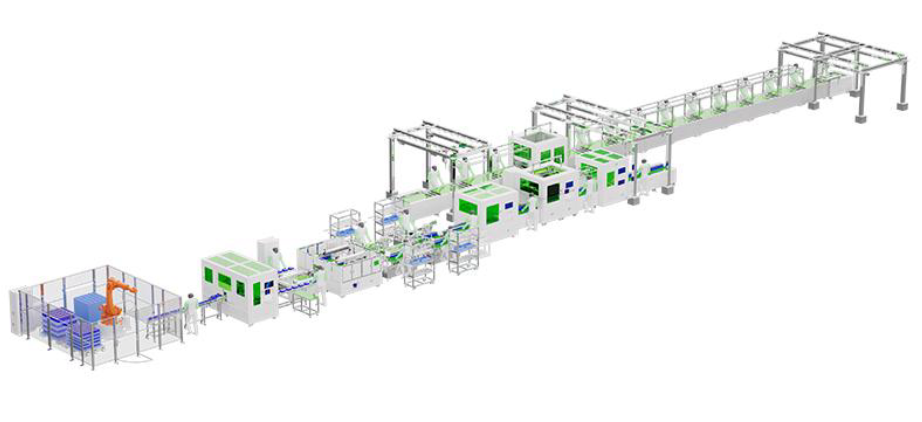
This is where takt time, cycle time, equipment availability and buffer capacity become important.
This article explains how to evaluate auxiliary equipment on a battery module line, identify potential bottlenecks, calculate capacity requirements and define the right performance criteria before ordering equipment.
A production line is only as capable as its constrained process. Matching auxiliary equipment to the line’s production requirements is part of the overall line design, not an afterthought.
1. What Counts as Auxiliary Equipment on a Battery Module Line?
Auxiliary equipment refers to machines and systems that support the main manufacturing process.
Depending on the product, process flow and factory layout, examples may include:
- Cell sorting machines
- Semi-automatic cell blue film wrapping machines
- Semi-automatic module welding stations
- Integrated cell cap testing machines combining helium leak detection and electrical testing
- Labeling and marking equipment
- Cleaning equipment
- Material handling and buffer systems
These machines may be installed directly in the production flow, operated as separate stations or shared between multiple production lines.
The distinction is important because the equipment’s position in the process determines how its capacity should be evaluated.
1.1 Is Auxiliary Equipment Always Outside the Main Production Line?
No.
The term “auxiliary” describes the equipment’s supporting role. It does not necessarily mean that the machine operates independently or outside the production flow.
For example, a semi-automatic welding station may be integrated directly into a module assembly sequence. In another factory, the same type of station may operate separately, with modules transferred to it in batches.
Similarly, a cell sorting machine may supply one production line or serve several downstream processes.
The equipment’s actual role should therefore be determined by the process flow and factory layout.
Before calculating capacity, identify:
- Whether every product passes through the machine
- Whether the machine operates continuously or in batches
- Whether it serves one line or multiple lines
- Whether material is transferred manually or automatically
- Whether a buffer separates it from the next station
These details determine how closely its operating rate needs to match the main line.
2. What Is the Difference Between Takt Time and Cycle Time?
Takt time and cycle time are closely related, but they describe different things.
Confusing them can lead to incorrect production capacity calculations.
2.1 Takt Time: The Required Production Rhythm
Takt time is the available production time divided by customer demand.
It describes how frequently a finished product needs to be completed to meet the required output.
For example:
A factory has 7.5 hours of net production time per shift and needs to produce 450 modules during that shift.
The calculation is:
[
\text{Takt Time}=\frac{7.5\times60\times60}{450}=60\text{ seconds}
]
This means the production line needs to complete one module every 60 seconds, on average, to meet the target.
The example assumes that the 7.5 hours already excludes planned breaks and other time that is not available for production.
2.2 Cycle Time: How Long a Process Actually Takes
Cycle time is the time required for a machine or process to complete one unit of work.
For a semi-automatic station, the cycle may include:
- Operator loading
- Product positioning
- Automatic processing
- Inspection
- Unloading
- Resetting for the next unit
The actual cycle time should be measured using the complete operating sequence, not just the machine’s automatic processing time.
For example, a machine may have an automatic processing time of 60 seconds. However, if loading, positioning and unloading increase the measured time between completed units to 75–85 seconds, its effective cycle time is longer than the headline figure.
Whether this is acceptable depends on the required takt time and the availability of buffers.
2.3 Why Does the Difference Matter?
Takt time represents what production needs.
Cycle time represents what a process can deliver under defined operating conditions.
If the effective cycle time is shorter than takt time, the station may have enough capacity to support the required output.
If the effective cycle time is longer than takt time, the station may become a bottleneck unless the process is redesigned, additional capacity is provided or a suitable buffer can compensate for temporary variations.
A buffer can absorb short interruptions, but it cannot permanently compensate for a machine whose average output is lower than the required consumption rate.
Takt time is driven by demand. Cycle time is determined by the process. The purpose of capacity planning is to make the two compatible.
3. Why Does Takt Matching Matter More Than Individual Machine Speed?
A production line does not operate as a collection of independent machines.
Its output depends on how the stations work together.
Consider a simplified example:
| Process | Effective cycle time |
|---|---|
| Cell positioning | 45 seconds |
| Stacking and compression | 55 seconds |
| Welding | 65 seconds |
| Inspection | 50 seconds |
If these stations operate in a one-piece flow arrangement without sufficient decoupling, the 65-second welding process may constrain the overall production rhythm.
The faster stations do not automatically increase the line’s output.
This is why buyers should look beyond the cycle time listed in an individual machine’s datasheet.
3.1 What Is Included in Effective Cycle Time?
Four factors commonly create a gap between a machine’s headline cycle time and its actual production performance.
Manual handling
Semi-automatic equipment depends on operator activity. Walking, positioning, loading, inspection and unloading all affect the production cycle.
Material availability
A machine cannot process products that have not arrived. Irregular upstream supply may cause unnecessary idle time.
Changeover and adjustment
Product changes may require fixture replacement, parameter selection, mechanical adjustment or trial runs.
Planned interruptions
Cleaning, consumable replacement, calibration checks and routine maintenance reduce the time available for production.
These factors should be considered when estimating effective capacity.
Where possible, cycle time should be measured using representative products and the actual operator model planned for production.
4. Where Does the Real Bottleneck Usually Occur?
A bottleneck is not always the machine with the longest automatic processing time.
It may occur at a machine, at a material transfer point or in the upstream supply process.
4.1 The Station With the Longest Effective Cycle Time
This is the most obvious type of bottleneck.
If a station consistently takes longer to complete each unit than the production rhythm allows, material may accumulate in front of it.
The solution may involve reducing processing time, improving handling, adding parallel capacity or changing the production arrangement.
4.2 The Interface Between Two Stations
Two machines may both have sufficient individual capacity but still create a queue.
For example, if an operator transfers modules manually between stations, the transfer time and operator availability may affect the handover.
A poorly designed buffer or transfer arrangement can also prevent the downstream machine from receiving products at the right time.
The interface should therefore be evaluated as part of the production process.
4.3 Unstable Upstream Material Supply
A cell sorting machine may have sufficient average capacity but still fail to supply a downstream line consistently.
This can happen when output arrives in irregular batches, when incoming material varies or when changeover interrupts the supply process.
The downstream station may then stop because it has no material to process.
A production queue often develops where process variability meets a capacity constraint. The buffer determines how much of that variation the line can absorb.
4.4 How Can the Real Bottleneck Be Identified?
Use production observation together with cycle-time records.
Run the line or a representative section under realistic operating conditions.
Record:
- Where products accumulate
- Which stations frequently wait for material
- Which machines remain idle between cycles
- How often operators need to intervene
- How long changeovers and minor stoppages take
If modules repeatedly accumulate before a particular station, that station or its upstream interface may be constrained.
If operators are waiting for products, the problem may be upstream.
If a machine frequently waits after completing its cycle, the downstream process may be unable to accept its output.
The purpose is to identify the actual constraint before deciding which machine needs more capacity.
5. Should Auxiliary Equipment Run Faster Than the Main Line?
Sometimes, yes.
An auxiliary machine may need additional capacity if it receives material in batches, experiences variable loading times or must recover from short interruptions without stopping the main line.
Inspection equipment may also need extra capacity because rejected products, confirmation tests or additional checks can consume processing time.
As a preliminary planning reference, some projects consider a capacity margin of approximately 10–25% above the required production rate for stations that need to absorb variability.
However, this is not a universal engineering standard.
The appropriate margin depends on:
- Incoming material variation
- Expected stoppage frequency
- Rework and retest requirements
- Operator handling time
- Equipment availability
- Required production output
The margin should be confirmed through capacity calculations and representative production trials.
5.1 When Is Additional Capacity Not Necessary?
A machine does not always need to match the main line’s takt directly.
If it is separated from the main flow by a properly sized buffer, it may operate at a different cycle time while still maintaining sufficient average output.
For example, a machine may process products in batches rather than one at a time.
The buffer allows the downstream line to continue operating while the auxiliary machine completes its next batch or recovers from a short interruption.
However, the machine must still replenish the buffer at a sufficient average rate.
A buffer cannot solve a permanent capacity shortage.
6. When Can Auxiliary Equipment Run More Slowly Than the Main Line?
Some auxiliary processes can operate more slowly than the main line when their work is organized in batches or when they are separated by adequate buffer capacity.
6.1 Batch Processing
A blue film wrapping machine, for example, may be configured to handle products in a batch-based process rather than as part of a continuous one-piece flow.
In this case, evaluating only the cycle time of one cell may be misleading.
The more useful measurements are:
- Number of cells processed per batch
- Total batch processing time
- Loading and unloading time
- Time required to prepare the next batch
- Frequency of material replenishment
The machine must be able to supply the required number of processed cells over the production period.
6.2 Equipment Shared Between Multiple Lines
An auxiliary machine may also serve more than one production line.
This can reduce equipment investment, but the combined demand of all connected lines must be considered.
For example, if two lines require material from the same machine, its total required output is the sum of both lines’ consumption.
The machine’s available capacity must be sufficient to meet that combined demand, including changeover and planned downtime.
6.3 What Must Be Planned for Shared Equipment?
Three conditions are particularly important.
A defined production schedule
Each line needs a clear allocation of the shared machine’s operating time.
Adequate buffer capacity
Each connected line needs enough material to continue operating while the shared machine serves another line.
A practical changeover procedure
If the shared machine requires frequent model changes, the changeover time must be included in the capacity calculation.
Shared equipment may be suitable for low-volume, high-mix production. It becomes more difficult to manage when several lines operate at high utilization with overlapping demand.
7. How Should Buffer Capacity Be Calculated?
A buffer is designed to absorb temporary differences between upstream supply and downstream demand.
It can help protect production from short stoppages and cycle-time variation.
A simple starting point is:
[
\text{Required Buffer Quantity}=\text{Downstream Consumption Rate}\times\text{Buffer Coverage Time}
]
For example, if a downstream process consumes one module every 60 seconds and the buffer needs to cover 10 minutes of upstream interruption:
[
\text{Buffer Quantity}=\frac{10\times60}{60}=10\text{ modules}
]
This is a simplified planning calculation. Actual buffer design should also consider product handling, storage space, safety requirements and material transfer arrangements.
7.1 Buffer Before a Station
A buffer before a machine provides material so that the machine can continue operating during a temporary upstream interruption.
Its purpose is to reduce the effect of upstream downtime.
7.2 Buffer After a Station
A buffer after a machine provides temporary storage for completed products when the downstream process is unavailable.
It allows the upstream machine to continue working for a limited period.
7.3 What Is a Reasonable Buffer Size?
For some semi-automatic production arrangements, a buffer equivalent to approximately 5–15 minutes of downstream consumption may be used as an initial planning reference.
This is not a fixed requirement for every line.
The final buffer size should be based on actual or expected stoppage duration, product mix, operator availability, factory space and the cost of additional equipment capacity.
A buffer that is too small may fail to protect the line from normal interruptions.
A buffer that is unnecessarily large may increase floor-space requirements, material handling and work-in-process inventory.
The goal is to provide enough protection without creating an unnecessarily complicated production layout.
8. How Does Product Changeover Affect Takt Matching?
Changeover reduces the time available for production.
A line that produces one product continuously may operate close to its planned capacity. A line that changes between several module models during a shift has less time available for actual production.
This means that capacity planning should consider more than the cycle time of a single successful production cycle.
The total production plan should also include:
- Changeover frequency
- Fixture replacement time
- Program selection and parameter adjustment
- Trial production after changeover
- First-piece inspection
- Material preparation
8.1 Which Auxiliary Machines Are Sensitive to Changeover?
Machines with product-specific fixtures and programs often require additional changeover planning.
Examples may include:
- Welding stations
- Electrical testing stations
- Blue film wrapping machines
- Cell sorting machines
The actual changeover requirements depend on the equipment design and compatible product range.
8.2 How Can Changeover Time Be Reduced?
Several measures may help:
Pre-stored production recipes
The correct program and parameters can be selected according to the product model.
Quick-change fixtures
Where practical, quick-release structures can reduce mechanical adjustment time.
Offline preparation
Fixtures, materials and tools can be prepared before the line stops.
Standardized changeover procedures
A documented sequence helps operators complete model changes consistently.
For flexible battery module production, changeover capability should be considered during equipment design rather than added after the line is completed.
9. How Does Equipment Availability Affect Capacity?
A machine may have a cycle time that meets the required takt but still fail to deliver the expected production output if it is unavailable for part of the shift.
Availability refers to the proportion of scheduled production time during which the equipment is actually available to operate.
For example, if a machine has a theoretical capacity of 100 units per hour and an assumed availability of 90%, its availability-adjusted capacity is:
[
100\times90%=90\text{ units per hour}
]
This is a simplified calculation. It does not include additional losses from reduced operating speed or defective products.
When evaluating overall equipment effectiveness (OEE), availability, performance and quality should be considered separately.
9.1 Why Should Availability Assumptions Be Documented?
A capacity calculation based on 100% availability may look attractive on paper but may not reflect actual production conditions.
The supplier and customer should agree on the assumptions used in the capacity calculation.
Where historical operating data exists, it can provide a more realistic basis.
For new equipment without historical data, the assumed availability should be clearly identified and verified during production trials and acceptance testing.
10. How Should Auxiliary Equipment Capacity Be Verified Before Ordering?
Before placing an order, buyers should verify that the proposed equipment can support the required production rhythm.
Three steps are particularly useful.
10.1 Review a Documented Cycle-Time Breakdown
Ask the supplier to provide a breakdown of the expected cycle time.
Depending on the process, this may include:
- Automatic processing time
- Loading and unloading time
- Operator handling time
- Waiting time
- Changeover time
- Planned interruption assumptions
- Expected availability
This helps distinguish a machine’s headline speed from its expected production performance.
10.2 Conduct a Sample Run
If representative parts are available, ask the supplier to conduct a sample run.
The test should use products and handling conditions that resemble actual production.
For semi-automatic equipment, the operator model should also be considered.
A demonstration using specially prepared parts or unusually favorable conditions may not reflect normal factory operation.
10.3 Define FAT Performance Requirements
The Factory Acceptance Test (FAT) should include measurable performance requirements.
Depending on the machine, these may cover:
- Product compatibility
- Automatic and manual operating functions
- Cycle time
- Changeover procedure
- Inspection or process results
- Data recording
- Reject handling
- Continuous operation over an agreed test period
The test duration, product samples and acceptance criteria should be agreed before manufacturing is completed.
11. What Should Be Included in the Technical Agreement?
Takt matching should be translated into measurable project requirements.
At minimum, the technical agreement should define:
- Required line takt: The target production rhythm and the assumptions used to calculate it.
- Auxiliary equipment capacity: The required effective cycle time or output rate for each machine.
- Handling model: Whether loading, unloading and transfer are manual, semi-automatic or automatic.
- Buffer capacity: The agreed buffer quantity or coverage time between relevant stations.
- Changeover requirements: The permitted changeover time and the product formats supported.
- Availability assumptions: The figures used in the production capacity calculation.
- Acceptance procedure: How cycle time, output and other performance requirements will be measured during FAT.
Each requirement should be specific enough to verify.
If the expected output is stated without defining the product, operating conditions and measurement method, both parties may interpret the result differently during acceptance.
Capacity matching should be calculated during engineering design and verified through production-representative testing before shipment.
12. Frequently Asked Questions
Does a faster auxiliary machine always improve the output of a module line?
No.
If the main bottleneck is located at another station, increasing the speed of an already unconstrained machine may not increase total line output.
The actual constraint should be identified before additional capacity is purchased.
Can auxiliary equipment operate below the main line takt?
Yes, in some configurations.
Batch processing, buffer storage and shared equipment arrangements can allow an auxiliary machine to operate at a different cycle time.
However, its average output must still be sufficient to meet the combined production demand.
How much additional capacity should an auxiliary machine have?
There is no universal margin.
A planning margin of approximately 10–25% may be considered for some stations that need to absorb process variation, but the final value should be based on the product, handling method, expected stoppages and production requirements.
Can takt matching be evaluated without sample testing?
A calculation can identify obvious capacity mismatches during the design stage.
However, confirming effective cycle time and operator handling performance normally requires testing with representative parts under realistic operating conditions.
Does a larger buffer always improve production efficiency?
No.
A larger buffer can protect the line from temporary interruptions, but it also requires more floor space and may increase work-in-process inventory.
Buffer capacity should be designed according to the actual production risks and material flow.
Conclusion
A battery module production line reaches its planned output only when its main stations, auxiliary equipment and material-handling processes work together.
The fastest machine does not necessarily determine the line’s capacity. The actual result depends on effective cycle time, equipment availability, operator handling, changeover requirements and the way material moves between stations.
For equipment buyers, the important step is to evaluate auxiliary equipment as part of the complete production system.
Define the required takt, calculate the capacity of each station, identify potential bottlenecks and confirm buffer arrangements before the equipment is ordered.
A well-planned line does not need every machine to run at the same speed. It needs every process to provide enough capacity to support the required production output.
About Shenzhen Jialuo Intelligent Technology Co., Ltd.
Established in 2008, Shenzhen Jialuo Intelligent Technology Co., Ltd. has focused on new energy equipment since 2019.
Jialuo provides automation equipment and customized production solutions for battery manufacturing, including battery module PACK assembly lines, automatic battery module steel strap production lines, CCS production lines and supporting equipment.
Its supporting equipment portfolio includes cell sorting machines, semi-automatic cell blue film wrapping machines, semi-automatic module welding lines and integrated cap testing machines combining helium leak detection, electrical performance testing and film application.
Equipment configuration can be discussed according to the customer’s cell specifications, module design, process requirements, production capacity and factory layout.
Contact Jialuo Intelligent
Email: jch@cnjialuo.com
Website: www.cnjialuo.com