
Buying a battery module PACK line does not always mean buying from a supplier nearby.
A battery manufacturer in Europe, Southeast Asia or South America may work with an equipment supplier in Shenzhen, China. The teams may be thousands of kilometres apart, speak different languages and operate in different time zones.
Yet the project still needs to meet the same requirements: the equipment must be correctly designed, manufactured, tested, delivered, installed and commissioned to achieve the agreed production targets.
Distance changes how the project is managed. More technical decisions need to be documented before manufacturing begins. Video meetings, drawings, sample testing and digital records become important tools for communication and verification.
But distance does not make a project impossible, nor does it automatically make it risky.
The key is to establish clear responsibilities, technical specifications and acceptance criteria before the equipment is shipped.
This article explains how overseas buyers can work with a battery module PACK line supplier in Shenzhen, from initial technical discussions and factory acceptance testing to overseas installation, commissioning and after-sales support.
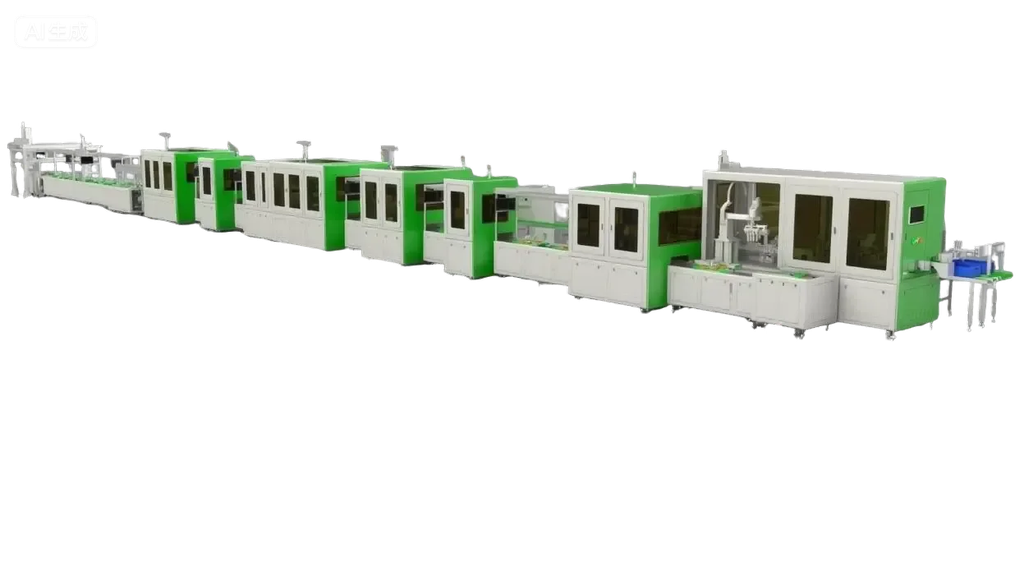
1. What Does a Battery Module PACK Line Project Actually Involve?
A battery module PACK line is not a single machine. It is a coordinated production system consisting of multiple stations, material-handling equipment and control interfaces.
For a prismatic cell module production line, a typical process may include:
- Cell inspection and OCV sorting
- Cell loading, flipping and pairing
- Adhesive application, where required
- Cell stacking and compression
- Polarity positioning and addressing
- Laser cleaning
- Busbar installation and welding
- Electrical testing
- Module assembly and PACK-related processes
The actual process depends on the cell format, module design, production capacity and automation requirements.
Cylindrical and pouch cell production lines require different handling methods and process configurations.
When a project is managed remotely, the most important technical discussions are not limited to individual machines. The interfaces between stations also need to be clearly defined.
Each interface involves three key elements:
- Mechanical interface: How is the product transferred and positioned?
- Electrical and data interface: How are signals, control information and production records exchanged?
- Production timing: Can the upstream and downstream stations operate at the required cycle time?
If these details are confirmed during the design stage, installation and commissioning become more predictable.
If they are left unresolved until the equipment arrives, both sides may need to spend additional time and money correcting the design on site.
2. What Should Be Confirmed Before Ordering a PACK Line?
For an overseas buyer, preparing the technical requirements is one of the most important steps in a remote purchasing project.
A detailed specification helps the supplier understand the application and reduces the risk of misunderstandings.
2.1 Product and Cell Specifications
Start with the product itself.
The supplier needs to understand:
- Cell format: prismatic, cylindrical or pouch
- Cell dimensions and specifications
- Module dimensions and weight
- Cell quantity and arrangement in each module
- Series and parallel configuration
- Number of product models
- Expected future product variations
A production line designed for one module configuration may be very different from a flexible line required to handle several module sizes.
Multiple product models may require additional fixtures, adjustable mechanisms, different recipes or a more flexible control system.
Providing accurate drawings and product information early helps the engineering team evaluate these requirements.
2.2 Required Production Capacity
Production capacity should be defined with clear operating assumptions.
For example, a target expressed as modules per shift should also specify:
- Working hours per shift
- Number of shifts per day
- Working days per year
- Target output for each product model
- Expected changeover frequency
- Required equipment availability
- Whether the target refers to theoretical or actual production output
It is also important to identify the bottleneck stations.
A line’s overall output is determined by how its stations work together, not simply by the speed of its fastest machine.
2.3 Process Scope and Supply Boundaries
Not every customer needs a complete production line.
Some manufacturers already have welding or testing equipment and only need upstream or downstream automation.
Others require a complete solution from cell feeding and sorting through module assembly and PACK closing.
Before quotation, both parties should define:
- Which machines are included
- Which processes are excluded
- Which equipment is supplied by the customer
- Which utilities and auxiliary systems are required
- Where the supplier’s responsibility ends and the customer’s begins
A clearly defined supply scope helps prevent unexpected costs and delays.
2.4 Local Standards and Factory Requirements
The equipment must also meet the requirements of the destination factory.
These may include:
- Electrical supply and electrical standards
- Machine guarding and safety requirements
- Emergency-stop and safety interlock arrangements
- Documentation language
- Factory network and communication requirements
- Local installation and inspection requirements
Any differences between the customer’s local standards and the supplier’s standard configuration should be discussed before manufacturing starts.
Retrofitting equipment after delivery may take more time and cost more than incorporating the requirements during the original design.
3. How Is a PACK Line Specified When the Buyer Cannot Visit Shenzhen?
When a customer cannot visit the supplier’s factory, technical decisions need to be based on information that both sides can review and verify.
Several methods make this possible.
3.1 Drawings and Technical Data Before Quotation
A supplier may request:
- Cell and module drawings
- 2D mechanical drawings
- 3D models, where available
- Product samples
- Process flow requirements
- Factory layout drawings
- Target production capacity
These documents are not just quotation attachments.
They help engineers evaluate fixture dimensions, robot reach, gripper design, sensor positions, equipment footprint and material transfer arrangements.
For customized equipment, accurate product drawings are particularly important.
If only a general product image or incomplete drawing is available, the supplier may need to make assumptions. Those assumptions should be identified and confirmed before the design is finalized.
3.2 Video Walkthroughs of Existing Equipment
A video walkthrough can help overseas buyers understand how a machine operates in a real production environment.
Whenever possible, request an actual operating video rather than relying only on presentation animations or equipment renderings.
Useful details to observe include:
- How cells and components are loaded
- How products move between stations
- How operators interact with the equipment
- How product changeover is performed
- How defective products are separated
- What information is displayed on the control screens
- How the equipment behaves during continuous operation
A video cannot replace an on-site inspection, but it can provide useful evidence of the equipment’s structure and operating process.
3.3 A Written Process Flow With Production Data
A process flow diagram should describe more than the names of the machines.
Where applicable, it should include:
- Process sequence
- Cycle time for each station
- Buffer arrangements
- Material transfer method
- Operator positions
- Reject handling
- Data communication requirements
This gives both engineering teams a common reference.
It also makes it easier to identify missing processes and potential bottlenecks before manufacturing begins.
3.4 Sample Testing Before Ordering
If the customer can provide cells, module components or representative samples, the supplier may be able to conduct preliminary process trials.
Depending on the equipment and available test conditions, these trials can help evaluate:
- Product positioning and handling
- Fixture compatibility
- Adhesive application
- Welding process feasibility
- Inspection methods
- Material transfer
Sample testing does not replace the final Factory Acceptance Test (FAT), but it can help resolve important technical questions before the equipment is ordered.
4. How Can a Buyer Conduct a Factory Acceptance Test Remotely?
The Factory Acceptance Test (FAT) is an important project milestone.
It allows the customer to verify the equipment’s functions and agreed performance before shipment.
If the buyer cannot travel to Shenzhen, several arrangements are possible.
4.1 Third-Party Inspection
The customer may appoint an independent inspection company or local representative to attend the FAT.
The inspection should follow a checklist agreed upon by both parties before the test.
The checklist may cover:
- Equipment configuration
- Safety functions
- Individual station operation
- Automatic operating sequence
- Product handling
- Changeover functions, if included
- Production cycle time
- Inspection results
- Data recording
- Identified issues and corrective actions
The buyer should define the acceptance requirements rather than relying only on a general inspection report.
4.2 Live Video FAT
A live video meeting can allow the buyer’s engineering team to observe the equipment operating in Shenzhen.
For a useful remote FAT, the procedure should be agreed in advance.
A practical arrangement may include:
- Confirm the test checklist and sample requirements.
- Show the equipment configuration and key stations.
- Run the agreed production sequence.
- Display relevant operating parameters and test results.
- Record any abnormal conditions or unfinished items.
- Share the test video and supporting records after the session.
Where practical, the camera should remain on during the agreed test sequence so that the buyer can observe the process without unnecessary interruptions.
The buyer should also have an opportunity to ask questions and request specific demonstrations.
4.3 Data-Based Acceptance
Not every acceptance item can be verified by watching a machine.
Some requirements are better supported by recorded data.
Depending on the equipment configuration, useful records may include:
- Cycle time records
- Production counts
- Reject records
- Welding monitoring data
- Inspection results
- Alarm history
- Traceability records
These records provide evidence that can be reviewed after the video meeting.
They are also useful for comparing the FAT results with the performance observed during installation and commissioning.
4.4 Agree on Acceptance Criteria Before Manufacturing
This is one of the most important points in an overseas equipment project.
The FAT criteria should be written into the technical agreement or another mutually approved document before the equipment is built.
Both parties should agree on what will be tested, how the results will be measured and how incomplete items will be handled.
If acceptance criteria are only discussed after the test, disagreements may arise because each party has a different understanding of what constitutes successful acceptance.
5. How Are Overseas Installation and Commissioning Arranged?
After the equipment passes the agreed pre-shipment checks, the project moves to delivery, installation and commissioning.
This stage requires coordination between the supplier’s engineering team and the customer’s local factory team.
5.1 Who Is Responsible for On-Site Installation?
There are several common arrangements.
Model A: Supplier-Led Installation
The supplier sends engineers to the customer’s factory to guide or carry out installation and commissioning. The customer provides local utilities, lifting equipment and other agreed support.
Model B: Supplier Engineers Plus Local Contractors
The supplier sends technical engineers, while local contractors assist with mechanical installation, cable routing and utility connections.
Model C: Customer-Led Installation With Remote Guidance
The customer’s engineering team completes part of the installation according to the supplier’s drawings and instructions. Supplier engineers then provide remote support or travel to the site for commissioning.
The most suitable arrangement depends on the project scope, local labor availability, installation capability and budget.
Responsibilities should be clearly stated in the project agreement.
5.2 How Long Does Installation and Commissioning Take?
There is no single commissioning duration for every battery production line.
The schedule depends on:
- Number of machines and stations
- Automation level
- Mechanical and electrical complexity
- Factory readiness
- Customer product samples and materials
- Local installation resources
- Scope of process debugging and training
As reference examples from different project scopes, a steel strap production line may require approximately 7–10 days for commissioning in China once the equipment has arrived and the site is ready. A more complex battery module line may require around 30 days, depending on its configuration and commissioning scope.
These are indicative reference periods, not guaranteed schedules for every project.
For overseas projects, travel arrangements, local installation work and site conditions must also be included in the project plan.
The final schedule should be confirmed for each project before shipment.
5.3 What Should the Factory Prepare Before the Engineers Arrive?
Site readiness is one of the biggest factors affecting overseas commissioning schedules.
Before equipment delivery, the customer should prepare the following items according to the approved installation requirements:
- Factory floor and equipment foundations, where required
- Electrical power supply and distribution
- Compressed air supply
- Network access, if required
- Lifting equipment and unloading arrangements
- Installation tools and local technicians
- Production materials and representative samples
- Space for unpacking and temporary equipment storage
A pre-installation checklist should be shared and confirmed by both parties before shipment.
Photographs, videos and measurements can help the supplier review the site remotely.
This reduces the possibility of engineers arriving at a factory where essential utilities or installation conditions are still incomplete.
6. Where Do Remote PACK Line Projects Commonly Lose Time?
Most project delays are not caused by geographical distance alone.
They often result from technical information arriving too late, unclear responsibilities or incomplete site preparation.
6.1 The Factory Is Not Ready When the Equipment Arrives
The equipment may have completed international shipping while the factory floor, electrical supply or compressed air system is still unfinished.
This can delay installation and increase travel and labor costs.
How to reduce the risk:
Use a dated site-readiness checklist and request photographs or videos before shipment. Confirm the status again before the commissioning team travels.
6.2 Technical Documents Are Not Prepared in the Required Language
Electrical drawings, operating instructions and maintenance manuals may need to be available in English or another local language.
If language requirements are only discussed after delivery, translation and document revision may delay installation and training.
How to reduce the risk:
Confirm documentation language, file formats and delivery requirements during the quotation and technical agreement stages.
6.3 Spare Parts Are Not Confirmed Before Shipment
A worn gripper, sensor or other critical component may stop production if a replacement is not available.
For overseas customers, shipping a small replacement part can take time.
How to reduce the risk:
Agree on a recommended spare parts list before shipment. Identify critical wear parts, suggested quantities and expected replacement intervals.
6.4 Change Requests Arrive During Commissioning
A design change requested before manufacturing is usually easier to evaluate than a change requested after the equipment has been installed.
Late changes may affect mechanical structures, electrical wiring, control programs and the project schedule.
How to reduce the risk:
Establish a written change-control process. Each change should be reviewed for its technical impact, additional cost and effect on the delivery schedule before implementation.
6.5 Time-Zone Differences Are Not Considered
A buyer and supplier may have several hours of time difference.
If the project schedule assumes that both teams can respond immediately, technical decisions may be delayed.
How to reduce the risk:
Agree on a regular communication window that overlaps with both teams’ working hours.
Use written progress reports for routine updates and reserve live meetings for technical decisions that require discussion.
7. How Should After-Sales Support Be Arranged?
After the line has been installed and accepted, the support arrangement becomes part of the customer’s long-term production planning.
Remote support can be useful, especially when the supplier and customer are in different countries.
Depending on the equipment’s control system and the customer’s network and security policies, support may include:
Remote Technical Assistance
Engineers may help investigate equipment alarms, operating parameters and process questions through video calls or approved remote communication methods.
Remote Diagnostics
Where the equipment supports it and the customer authorizes access, remote diagnostics may help engineers review PLC status, alarm information and operating records.
Network access should follow the customer’s cybersecurity and IT requirements.
Spare Parts Support
A recommended spare parts list helps the customer prepare for routine maintenance and reduce the risk of unexpected downtime.
Critical parts and expected delivery lead times should be discussed before shipment.
On-Site Technical Support
Some issues cannot be resolved remotely.
When necessary, an on-site visit may be arranged according to the service agreement, issue severity and travel arrangements.
The agreement should clearly define warranty coverage, response arrangements, service responsibilities and any costs associated with overseas visits.
8. Six Questions to Ask Before Buying a PACK Line from Shenzhen
Before signing an equipment purchase agreement, overseas buyers should make sure they can get clear answers to these questions:
- What exactly is included in the equipment supply scope? Which stations, interfaces and auxiliary systems are included or excluded?
- What are the FAT acceptance criteria? Are they documented and agreed upon before manufacturing?
- How will the factory acceptance test be conducted? Can the buyer attend in person, appoint a third party or participate remotely?
- Who is responsible for overseas installation and commissioning? How many engineers are required, and who covers travel and accommodation?
- What technical documents will be provided? In which language and file format?
- How will after-sales support and spare parts be arranged? What support is available remotely, and when is an on-site visit required?
A supplier who can explain these points clearly before the order is usually easier to coordinate with throughout the project.
9. Frequently Asked Questions
Can I buy a battery module PACK line from China without visiting the supplier?
Yes. An overseas customer can evaluate and purchase equipment remotely if the project is supported by sufficient technical documentation, equipment videos, sample testing and a clearly defined FAT procedure.
A factory visit can provide additional confidence, but it does not replace a detailed technical specification and agreed acceptance criteria.
Is a third-party inspection necessary before shipment?
It depends on the project value, customer requirements and internal quality procedures.
For some projects, a third-party inspector can provide an additional level of verification. For others, a structured remote FAT with recorded test results may be sufficient.
The inspection scope should always be agreed in advance.
Can the customer’s local engineers install the equipment?
In some projects, yes.
Local engineers may handle equipment positioning, cable routing and utility connections according to the supplier’s drawings and instructions. Supplier engineers can then provide guidance, alignment, programming and process commissioning.
The division of responsibilities depends on the equipment configuration and the customer’s technical capability.
What happens if a problem occurs after the warranty period?
Support arrangements depend on the service agreement and the nature of the issue.
Remote technical assistance, spare parts supply and on-site service may be available under separately agreed terms.
A clear maintenance plan and recommended spare parts inventory can make long-term equipment support easier to manage.
What information should I prepare before requesting a quotation?
At a minimum, prepare the cell format and specifications, module drawings, product configuration, target production capacity, required process flow and factory layout.
If some information is not yet available, explain what has been confirmed and what remains under development. The supplier can then identify the technical details that need further clarification.
Conclusion
Buying a battery module PACK line from Shenzhen is not simply a matter of choosing equipment and arranging international shipping.
It is a project that requires coordination between the buyer’s product requirements, the supplier’s engineering design, factory acceptance testing, overseas installation and long-term technical support.
Distance changes how these activities are coordinated, but it does not remove the need for clear technical communication.
Successful remote projects usually share three important practices:
- Technical interfaces and supply responsibilities are defined before the order.
- FAT procedures and acceptance criteria are agreed upon before manufacturing.
- Factory readiness and installation responsibilities are confirmed before shipment.
For overseas buyers, the goal is not simply to find a supplier that can manufacture the machines. It is to work with an equipment partner that can coordinate the complete project from technical discussion to commissioning.
About Shenzhen Jialuo Intelligent Technology Co., Ltd.
Established in 2008, Shenzhen Jialuo Intelligent Technology Co., Ltd. has focused on new energy equipment since 2019.
Jialuo provides automation equipment and customized production solutions for battery manufacturing, including battery module PACK assembly lines, automatic battery module steel strap production lines, CCS production lines and supporting equipment.
From initial technical discussions and equipment design to pre-shipment assembly and commissioning, Jialuo works with customers to develop production solutions based on their product specifications, factory conditions and manufacturing targets.
For overseas projects, technical communication, equipment testing and installation arrangements can be discussed according to the project scope and customer requirements.
Email: jch@cnjialuo.com
Website: www.cnjialuo.com