
How to Select the Right Material, Dimensions, Tolerances, and Supplier for Battery Module Steel Straps
A steel strap is one of the smallest components in a battery module bill of materials, but it plays an important role in the mechanical integrity of the finished assembly.
It wraps around the battery module stack, helping maintain the compression established during module assembly and keeping the structure dimensionally stable during handling, transportation, and operation.
Despite its relatively simple appearance, a steel strap requires careful consideration of material grade, thickness, forming accuracy, bend geometry, welding quality, and insulation requirements.
A strap that does not meet the required specifications may cause assembly difficulties, inconsistent compression, or interference with adjacent components.
This guide explains how to select steel straps for prismatic battery modules, compare common stainless steel grades, define important dimensions and tolerances, and evaluate samples before moving into volume production.
It is written for procurement engineers, process engineers, and battery module designers who need to specify steel straps for lithium battery manufacturing.
A steel strap is a mechanical component, not an electrical conductor. Its primary function is to help maintain the module structure and compression defined by the battery design.
1. What Is a Steel Strap in a Battery Module?
A battery module steel strap, also known as a steel band, module band, or strapping strip, is a formed stainless steel component that wraps around a battery cell stack.
It works together with the end plates and other structural components to maintain the required module configuration.
Its main functions include:
- Helping maintain the designed compression of the cell stack
- Securing the module structure during transportation and handling
- Supporting dimensional stability during operation
- Helping maintain the relative positions of module components
- Providing mechanical support throughout the intended service conditions
A finished steel strap may contain several features depending on the module design:
- Punched locating features: Help position the strap against the end plate and prevent unwanted movement.
- Formed sections: Allow the strip to wrap around the module corners and follow the required geometry.
- Welded closure: Completes the loop and provides the required joint strength.
- Heat-shrink insulation sleeve: Provides electrical insulation where the strap passes close to conductive components.
Most battery module steel straps are manufactured to customer drawings rather than selected from standard catalogues.
Different module designs have different dimensions, end plate structures, compression requirements, and mounting arrangements. Therefore, the strap geometry and material specifications should be matched to the specific application.
2. Which Stainless Steel Grade Should You Choose?
Material selection is one of the most important decisions when specifying a battery module steel strap.
Three commonly considered austenitic stainless steel grades are 201, 301, and 304.
Each has different characteristics in terms of mechanical strength, work hardening, formability, corrosion resistance, and material cost.
The best choice depends on the module design and its expected operating environment.
Grade 201 Stainless Steel
Grade 201 is a lower-nickel austenitic stainless steel that is commonly considered where material cost is an important factor.
Its characteristics include:
- Relatively economical material cost
- Useful mechanical strength
- Suitable formability for many standard bending applications
- Lower corrosion resistance compared with 304 in many environments
For battery modules operating in dry and controlled environments, Grade 201 may be a suitable option when its mechanical and corrosion performance meets the project requirements.
However, humid, coastal, or condensing environments may require additional corrosion evaluation.
The suitability of Grade 201 should be confirmed against the enclosure design, environmental conditions, and applicable qualification tests.
Grade 301 Stainless Steel
Grade 301 is known for its ability to achieve higher strength through cold working.
It may be considered for applications requiring higher mechanical strength or a thinner material section.
Its characteristics include:
- High strength potential
- Significant work-hardening capability
- Different strength levels depending on temper condition
- Potential advantages where weight and material thickness are constrained
An important consideration is that Grade 301 should not be specified by grade name alone.
Its temper condition and mechanical properties must also be defined because different conditions can produce significantly different forming and springback behavior.
For a battery module strap, these properties directly influence bending accuracy, forming parameters, and the final mechanical performance.
Grade 304 Stainless Steel
Grade 304 is a widely used general-purpose austenitic stainless steel with good corrosion resistance.
It is often considered for applications where the module may encounter higher humidity or more demanding environmental conditions.
Its characteristics include:
- Good corrosion resistance in many common environments
- Good general-purpose formability
- Broad industrial availability
- Higher material cost than Grade 201 in many purchasing conditions
Grade 304 may provide additional corrosion resistance where the application requires it.
However, the final selection should still consider the actual operating environment, surface condition, material thickness, and qualification requirements.
How Should You Make the Final Material Selection?
There is no single stainless steel grade that is suitable for every battery module.
Three questions can help narrow the selection.
1. What is the operating environment?
Dry and controlled environments may allow Grade 201 to be considered. More demanding humidity and corrosion conditions may justify evaluating Grade 304.
2. What mechanical performance is required?
Where higher strength or a thinner strip is required, Grade 301 may be worth evaluating, provided the temper condition and forming characteristics are appropriate.
3. What qualification tests must the module pass?
If the battery module must meet specific humidity, corrosion, or mechanical testing requirements, material selection should be based on those requirements rather than material price alone.
Material selection should begin with the application requirements. Cost optimization comes after the required mechanical and environmental performance has been established.
3. Which Dimensions and Tolerances Matter Most?
Steel strap specifications include two important groups of dimensions:
- The dimensions of the original stainless steel strip.
- The dimensions of the finished formed strap.
These should be defined separately in the technical drawing and purchasing specification.
Finished Steel Strap Dimensions
The finished strap dimensions depend on the battery module structure and the geometry of the end plates.
For reference, one equipment configuration supports finished strap dimensions within the following range:
- Width: approximately 105–540 mm
- Length: approximately 200–2200 mm
These figures represent a reference processing range for a specific equipment configuration.
The actual finished dimensions must be confirmed against the module drawing, end plate geometry, and required assembly conditions.
Original Stainless Steel Strip Dimensions
The original strip material is specified separately.
For one reference equipment configuration, the compatible strip dimensions are:
- Strip width: approximately 10–40 mm
- Strip thickness: approximately 0.5–2.0 mm
Material thickness can influence mechanical strength, forming behavior, and the force required during bending.
A thicker strip may provide different mechanical performance, but it can also require greater forming force and more careful springback compensation.
The achievable processing range depends on material grade, temper condition, strip quality, and equipment configuration.
Final specifications should be confirmed during technical evaluation.
Which Tolerances Should Be Included in the Purchase Specification?
Three tolerance categories deserve particular attention.
Thickness tolerance
Thickness variation can influence the mechanical behavior of the finished strap.
Where the module design has a narrow mechanical tolerance window, material thickness should be controlled through clearly defined purchasing requirements and incoming inspection.
Width and length tolerance
These dimensions affect the fit between the strap, end plate, and locating features.
A strap may meet its thickness requirement but still cause assembly difficulties if its length or locating positions are incorrect.
Bend angle tolerance
Bend angles determine whether the formed strap follows the intended module geometry.
For reference, one steel strap forming equipment configuration achieves bend angle accuracy of approximately ±0.1°.
The required tolerance should be established according to the finished part drawing and assembly requirements.
Why Does Feed Accuracy Matter?
Strip feeding accuracy influences the positioning of punched features and the consistency of subsequent forming operations.
For reference, one equipment configuration achieves feed positioning accuracy of approximately ±0.2 mm.
Actual production results also depend on strip straightness, coil quality, feeding conditions, and equipment maintenance.
These figures should be treated as equipment reference values rather than automatic guarantees of finished-part dimensional accuracy.
Why Are Tolerances More Important Than Nominal Dimensions Alone?
A steel strap may meet its nominal dimensions but still show significant variation between production batches.
If thickness, bend angle, or locating positions vary, the finished module may experience inconsistent assembly conditions.
Possible consequences include:
- Difficulties during strap installation
- Variation in module geometry
- Inconsistent mechanical loading
- Interference with adjacent components
- Problems with subsequent module assembly operations
A purchasing specification should therefore include both nominal dimensions and acceptable tolerance ranges.
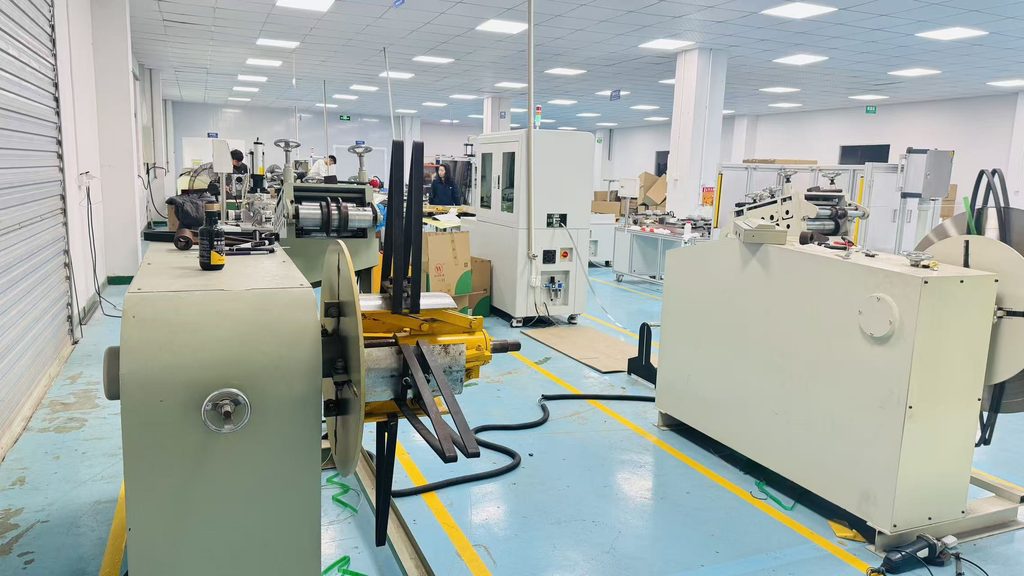
4. How Are Battery Module Steel Straps Manufactured?
A steel strap production line typically integrates several processes into a continuous manufacturing sequence.
Understanding these operations helps buyers evaluate supplier capabilities and identify potential sources of quality variation.
1. Decoiling and Levelling
Stainless steel strip is supplied in coil form.
The decoiling and levelling system feeds the material into the production line and reduces the original coil curvature.
Proper levelling is important because residual curvature may affect subsequent feeding, punching, and bending operations.
2. Punching and Blanking
The strip passes through a punching or blanking station to create locating features, holes, and other required geometric details.
Tool condition is important at this stage.
Worn punching tools may produce excessive burrs, dimensional deviations, or inconsistent hole positions.
Regular tool inspection and sample verification help maintain dimensional quality.
3. Insulation Sleeve Insertion
Where electrical insulation is required, a heat-shrink sleeve is positioned on the stainless steel strip.
The sleeve position must correspond to the insulation requirements of the finished module.
Incorrect positioning may leave part of the strap insufficiently covered or interfere with subsequent forming operations.
4. Heat Shrinking and Cooling
The sleeve is heated to shrink around the strip.
Heating temperature, dwell time, and cooling conditions influence the final sleeve position and appearance.
Uneven shrinking may result in wrinkles, insufficient coverage, or other defects that affect subsequent assembly.
5. Sleeve Trimming
Excess insulation material is trimmed according to the required finished dimensions.
The trimming process should avoid sharp edges or damaged sleeve sections that could interfere with adjacent insulation materials.
6. Bending and Forming
The stainless steel strip is formed into its final profile.
This is one of the most important stages in steel strap manufacturing.
Stainless steel has elastic recovery characteristics, commonly referred to as springback. After the forming force is released, the material may partially return toward its original shape.
The forming process must compensate for this behavior to achieve consistent finished bend angles.
Material grade, temper, thickness, and tooling design all influence the final forming result.
7. Welding
The ends of the formed strip are joined to complete the steel strap loop.
Weld quality is important because the joint must withstand the mechanical requirements of the finished assembly.
Visual appearance alone is not sufficient to establish joint strength.
The appropriate welding inspection and mechanical verification method should be defined according to the product specification.
8. Dimensional Inspection
Finished steel straps are checked against the approved drawing.
Important inspection items may include:
- Overall dimensions
- Bend angles
- Locating feature positions
- Strip thickness
- Forming consistency
- Welding position
In-line inspection can help identify dimensional drift during production, while additional sampling and verification provide further quality assurance.
9. Electrical Insulation Testing
Where the strap includes a heat-shrink insulation sleeve, the finished part may require dielectric strength testing.
This helps identify insulation defects such as pinholes, insufficient coverage, or damaged sleeve sections.
The test voltage and acceptance criteria should be established according to the module’s electrical safety requirements.
10. Joint Strength Testing
Mechanical testing verifies whether the welded closure meets the required joint strength.
A pull test may be used where appropriate to evaluate the strength of the completed joint.
The test method, sample quantity, and acceptance criteria should be defined in the quality specification.
Every manufacturing operation can influence the final steel strap. Consistent process control and traceable inspection records help maintain quality from the incoming material to the finished component.
5. What Should You Check Before Approving a Steel Strap Sample?
Sample approval is an important step before moving into mass production.
A component that looks acceptable at first glance may still contain dimensional or mechanical issues that only become apparent during assembly or testing.
A structured sample evaluation should cover the following five areas.
Dimensional Conformance
Measure the sample against the approved engineering drawing.
Check overall dimensions, strip thickness, locating features, and bend angles.
Thickness should be measured at multiple locations where the specification requires it, because variation along the strip may influence mechanical consistency.
Burr Condition
Inspect punched and cut edges carefully.
Excessive burrs or sharp edges may damage nearby insulation materials or interfere with assembly.
Magnified visual inspection can help identify defects that are difficult to see during ordinary handling.
Bend Consistency
Check bend angles and overall forming geometry across multiple samples from the same production batch.
A single sample may meet the drawing while other parts show noticeable variation.
Batch consistency is therefore as important as individual sample approval.
Insulation Sleeve Integrity
Where a heat-shrink sleeve is required, check:
- Sleeve position
- Coverage length
- Surface condition
- Wrinkles and deformation
- Visible damage or pinholes
Visual inspection should be combined with the specified electrical insulation test where applicable.
Weld Quality and Joint Strength
The welded closure should be evaluated against the approved quality requirements.
Ask the supplier for the relevant mechanical test records.
Where batch traceability is required, the records should be associated with the actual production batch rather than relying only on a general quality certificate.
A sample that passes dimensional inspection but has no evidence of joint strength verification has not completed the full quality evaluation.
6. How Do Steel Straps Affect Battery Module Assembly?
Steel straps are not independent components. Their dimensions and mechanical properties interact with the module assembly process.
Understanding these interfaces helps prevent problems when introducing a new strap supplier or changing module designs.
How Does the Steel Strap Work With the Cell Stacking Station?
In a typical prismatic battery module assembly process, cells are stacked and positioned according to the required module configuration.
The compression system establishes the specified assembly condition, while the steel strap and structural components help maintain the designed configuration.
The strap specification and the compression process should therefore be evaluated together.
A mismatch between the strap geometry and the module design may lead to assembly difficulties or inconsistent results.
What Happens When the End Plate Design Changes?
The end plate is an important locating and structural component in many module designs.
Steel strap positioning features are often designed to match the end plate geometry.
If the end plate dimensions or locating positions change, the strap design may also require modification.
For this reason, drawing revisions should be communicated to the strap supplier before production.
Why Can Steel Strap Tolerances Affect Busbar Alignment?
The steel strap helps maintain the module’s mechanical structure and dimensional configuration.
If the finished strap dimensions or locating positions vary, the relative position of other module components may also be affected.
This can create additional challenges for downstream assembly operations, including busbar positioning and welding.
Steel strap dimensional control should therefore be considered part of the overall module manufacturing quality system.
How Does the Steel Strap Fit Into a Module PACK Production Line?
In a battery module PACK production line, steel strap application is one of several connected manufacturing operations.
It may interact with:
- Cell stacking and compression
- End plate positioning
- Steel strap installation
- Busbar and CCS assembly
- Electrical testing
- Final module inspection
For manufacturers producing several module designs, strap changeover requirements should also be included in the overall production planning.
7. What Should Buyers Ask About Supplier Capacity and Lead Time?
Choosing a steel strap supplier involves more than comparing unit prices.
Buyers should understand the supplier’s actual manufacturing capability, production capacity, and delivery arrangements.
How Much Production Capacity Can a Supplier Provide?
A supplier’s capacity statement should include three elements:
- Number of production lines
- Designed production capacity
- Shift arrangement used for the calculation
A monthly capacity figure without these details may be misleading.
For reference, Jialuo operates two in-house steel strap production lines, with a combined design capacity of approximately 200,000 straps per month on a two-shift basis.
This figure represents design capacity under the stated operating arrangement, not a guaranteed monthly delivery quantity.
Actual output depends on the strap specifications, production schedule, product mix, and order requirements.
Is Equipment Installation Time the Same as Delivery Time?
No. These are separate project milestones.
For a steel strap production line, on-site installation and commissioning typically takes approximately 7–10 working days for domestic projects.
Other module production lines may require approximately one month, depending on the configuration.
For overseas projects, on-site installation and commissioning is generally completed within one month, subject to site readiness and project conditions.
These figures refer to installation and commissioning only. Equipment manufacturing, transportation, customs clearance, and site preparation should be considered separately when planning the overall project schedule.
What About Steel Strap Sample Costs?
Sample costs depend on the strap dimensions, material grade, forming requirements, tooling requirements, and requested quantity.
For customized steel straps, sample arrangements and any associated tooling costs should be confirmed before production begins.
It is also important to establish whether the approved sample will be used as the reference standard for subsequent mass production.
8. Frequently Asked Questions About Battery Module Steel Straps
What Is the Difference Between a Steel Strap and a Busbar?
A steel strap is a mechanical component that helps maintain the battery module structure and compression.
A busbar is an electrical component that carries current between battery cells.
The two components have different functions, materials, manufacturing processes, and quality requirements.
Can Steel Straps Be Manufactured According to Customer Drawings?
Yes. Battery module steel straps are generally customized according to the customer’s drawings and module design.
The drawing should specify:
- Stainless steel grade and temper condition
- Original strip thickness and tolerance
- Finished dimensions
- Bend angles and tolerances
- Locating feature positions
- Insulation sleeve requirements
- Welding and joint strength requirements
Providing complete technical information helps the supplier evaluate manufacturing feasibility and prepare a more accurate quotation.
Does a Thinner Steel Strap Always Reduce Cost?
Not necessarily.
A thinner strip may reduce material consumption, but it also changes the mechanical performance and forming behavior.
The final selection should consider the required mechanical strength, compression conditions, material grade, and manufacturing tolerances.
A lower material cost does not automatically mean a lower total production cost.
How Should Steel Strap Quality Be Controlled During Mass Production?
Quality control should combine incoming material inspection, in-process monitoring, and finished-part verification.
Important checks may include:
- Material thickness and width
- Finished dimensions and bend angles
- Burr condition
- Insulation sleeve coverage
- Weld quality
- Joint strength records
Inspection frequency and acceptance criteria should be established according to the product’s technical requirements.
Do All Battery Module Steel Straps Require Insulation Sleeves?
No.
Insulation requirements depend on the module structure, electrical clearances, and the position of the steel strap relative to conductive components.
Where the strap passes close to live components, a suitable insulation sleeve may be required.
The insulation coverage and dielectric test requirements should be defined by the module design.
What Information Is Needed to Request a Steel Strap Quotation?
To prepare an accurate quotation, buyers should provide:
- A product drawing or complete dimensional specification
- Stainless steel grade and temper condition
- Material thickness and required tolerances
- Insulation sleeve requirements
- Welding and joint strength requirements
- Estimated order quantity and annual demand
- Delivery destination
The more complete the technical information, the easier it is to evaluate manufacturing feasibility, sample requirements, pricing, and delivery schedules.
About Jialuo Intelligent
Shenzhen Jialuo Intelligent Technology Co., Ltd. was established in 2008 and has focused on new energy automation equipment since 2019.
The company designs and manufactures lithium battery automation equipment, including battery module PACK production lines, automatic battery module steel strapping lines, CCS production lines, and supporting equipment such as helium leak testing, cell sorting, and blue film wrapping machines.
Jialuo operates two in-house steel strap production lines, with a combined design capacity of approximately 200,000 straps per month on a two-shift basis.
Steel straps can be manufactured according to customer drawings using 201, 301, and 304 series stainless steel, subject to the specified material condition and product requirements.
Customers can work with Jialuo for individual steel strap components or discuss integrated equipment solutions for steel strap forming and battery module PACK assembly.
The company holds National High-Tech Enterprise status, certificate no. GR202544206903, and is recognized as a Shenzhen Specialized, Refined, Distinctive and Innovative SME. Its management systems include ISO 9001 and ISO 14001.
Company: Shenzhen Jialuo Intelligent Technology Co., Ltd.
Address: Room 101, Building 2, No. 8, Kengcheng Guanggu Industrial Park, Dafu Community, Guanlan Street, Longhua District, Shenzhen, China
Email: jch@cnjialuo.com
Website: www.cnjialuo.com
Looking for a Steel Strap Manufacturer or Production Line Supplier?
Whether you are sourcing customized steel straps for an existing battery module or planning an automatic steel strap forming line for your factory, the first step is to define the product specifications and production requirements.
Share your module drawing, material requirements, target dimensions, annual demand, and delivery destination with our team.
Jialuo Intelligent can evaluate the manufacturing requirements and discuss suitable steel strap specifications, sample production, and equipment solutions.
The right steel strap is not simply the one that fits the drawing. It is the one that meets the mechanical requirements and maintains consistent quality throughout production.